

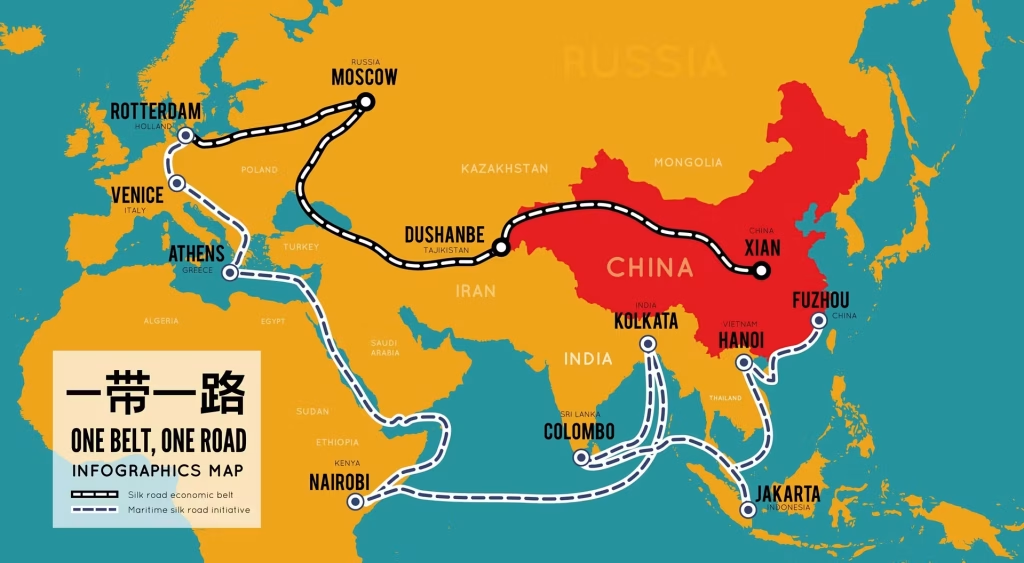
For foreign companies, this creates both opportunity and complexity. OBOR/BRI may open doors in logistics, green energy, digital trade, manufacturing, professional services, compliance, sourcing, and regional project work. But companies still need the right China market entry structure, local hiring model, payroll setup, tax planning, and compliance process. Policy direction can create opportunity, but execution still depends on people, contracts, payroll, and local operating capability.
What does OBOR China mean in 2026?
OBOR means One Belt One Road. It refers to the same broad initiative now usually called the Belt and Road Initiative. The original concept combined a land-based Silk Road Economic Belt with a sea-based 21st-Century Maritime Silk Road. Over time, BRI expanded beyond physical corridors into digital, green, financial, trade, standards, and people-to-people cooperation.
China’s official BRI white paper takeaways describe the initiative as based on extensive consultation, joint contribution, and shared benefits, while also emphasizing open, green, clean, and sustainable cooperation. For businesses, this means BRI is best understood as a policy and connectivity framework, not only a construction program.
| Term | Meaning | Business relevance |
|---|---|---|
| OBOR | One Belt One Road, the earlier English name. | Still used in search, but less common in official current business discussions. |
| BRI | Belt and Road Initiative, the current common term. | Used in policy, trade, investment, logistics, infrastructure, and business analysis. |
| Silk Road Economic Belt | Land-based connectivity routes. | Relevant for rail, inland ports, logistics, Central Asia, Europe links, and industrial corridors. |
| 21st-Century Maritime Silk Road | Sea-based trade and logistics routes. | Relevant for ports, shipping, Southeast Asia, Africa, the Middle East, and maritime supply chains. |
| Digital Silk Road | Digital infrastructure and technology connectivity. | Relevant for e-commerce, data centers, telecoms, fintech, cloud, cybersecurity, and smart logistics. |
| Green Silk Road | Green development and sustainability under BRI. | Relevant for renewable energy, ESG, environmental services, energy storage, and green finance. |
How does China’s 15th Five-Year Plan change the OBOR discussion?
The 15th Five-Year Plan covers 2026 to 2030. China’s official 2026–2030 development blueprint emphasizes high-quality development, innovation, people’s well-being, green transition, security, manufacturing upgrading, emerging industries, and opening. For business, this means BRI should now be read through the lens of higher-quality growth rather than only expansion of project volume.
A 2026 foreign-ministry explanation of China’s 15th Five-Year Plan states that the plan emphasizes expanding high-standard and voluntary opening up, improving institutional and regulatory frameworks aligned with high-standard economic and trade rules, and advancing high-quality Belt and Road cooperation. It also notes development goals related to R&D growth, innovation, green transition, and security.
For companies, this changes the OBOR question from “Which infrastructure projects are being built?” to “Where will China’s next phase of cross-border business require technology, services, people, compliance, risk management, and supply-chain capability?”
| Earlier OBOR focus | 15th Five-Year Plan business focus | What this means for companies |
|---|---|---|
| Large transport and infrastructure projects | Higher-quality cooperation and project sustainability | More attention to commercially viable projects, risk management, and local implementation. |
| Physical connectivity | Multidimensional connectivity, including rules, standards, digital systems, logistics, and platforms | More opportunities for software, logistics, compliance, professional services, and technical integration. |
| Outbound construction contracts | Industrial-chain cooperation and two-way investment | Foreign companies may participate as suppliers, partners, service providers, or China-based support teams. |
| Project expansion | Risk control, overseas-interest protection, and sustainable financing | Due diligence, governance, tax, HR, dispute resolution, and compliance become more valuable. |
| Traditional trade routes | Digital trade, green economy, AI, advanced manufacturing, and services | SMEs and specialized service providers may find new entry points beyond construction. |
Why does OBOR still matter for foreign companies?
OBOR matters because it influences trade routes, investment flows, industrial corridors, port development, rail links, digital infrastructure, energy projects, and Chinese companies’ overseas expansion. Even a company that never bids on a BRI infrastructure project may still be affected through customers, suppliers, logistics networks, Chinese partners, or regional demand.
The World Bank BRI economic impact report frames BRI as a connectivity initiative that can reduce trade costs and affect trade, income, and development outcomes, while also emphasizing that complementary policy reforms and risk management are important. That is the right business lens: connectivity can create opportunity, but the gains are not automatic.
For foreign companies, OBOR may matter in five practical ways:
- Supplier access: China-based manufacturers may supply projects in Belt and Road markets.
- Customer access: Chinese companies going global may need technology, compliance, logistics, HR, legal, finance, and operational support.
- Project staffing: Cross-border projects need engineers, project coordinators, supply-chain managers, compliance specialists, and bilingual teams.
- Market entry: Foreign companies may use China as a coordination base for regional expansion.
- Risk management: Projects across multiple jurisdictions need stronger payroll, tax, employment, sanctions, ESG, and contract controls.
Which sectors are most relevant under OBOR and the 15th Five-Year Plan?
The strongest business opportunities are likely to sit at the intersection of BRI connectivity and 15th Five-Year Plan priorities. That includes digital infrastructure, green energy, advanced manufacturing, logistics, professional services, and high-value industrial cooperation.
| Sector | Why it matters under OBOR and the 15th Plan | Likely business opportunities | Likely China hiring need |
|---|---|---|---|
| Digital infrastructure | Digital connectivity is increasingly tied to cross-border trade, e-commerce, smart logistics, and platform services. | Cloud systems, cybersecurity, data centers, fintech, AI logistics, SaaS, and digital trade platforms. | Sales engineers, technical support, implementation managers, cybersecurity and compliance staff. |
| Green energy and ESG | High-quality BRI cooperation increasingly emphasizes sustainability and green development. | Renewable energy, grid technology, energy storage, environmental services, ESG reporting, and green finance. | Project engineers, ESG analysts, compliance managers, supplier quality staff, and project coordinators. |
| Advanced manufacturing | China’s 15th Plan continues to emphasize industrial upgrading, intelligent manufacturing, and emerging industries. | Robotics, automation, machine vision, industrial software, quality systems, AI hardware, and precision components. | QA/QC managers, sourcing managers, supplier quality engineers, and technical project managers. |
| Logistics and supply chain | BRI corridors can reshape routes, delivery times, customs processes, and regional distribution. | Freight forwarding, rail-sea logistics, warehousing, customs coordination, and supply-chain visibility tools. | Logistics managers, customs specialists, procurement managers, and regional operations staff. |
| Professional services | Higher-quality BRI requires stronger legal, tax, payroll, HR, risk, and dispute-resolution support. | Compliance advisory, payroll, EOR, legal support, accounting, due diligence, and project governance. | HR managers, payroll specialists, bilingual compliance officers, and project administrators. |
| Healthcare, agriculture, and public services | Smaller, people-focused BRI projects can create demand beyond hard infrastructure. | Medical devices, cold chain, agritech, training, public-health systems, and technical services. | Regulatory affairs staff, technical support teams, local project coordinators, and field operations staff. |
How does OBOR connect with China market entry?
OBOR should not replace a China market entry plan. It should be one input into that plan. A practical China market entry guide should still begin with the fundamentals: target customers, product fit, local partners, pricing, compliance exposure, hiring model, entity structure, tax, payroll, and operational control.
OBOR becomes relevant when the company’s China opportunity is connected to cross-border trade, Chinese outbound investment, Belt and Road partner markets, logistics networks, green energy projects, digital infrastructure, or supply chains serving third countries. In those cases, the company may need China-based staff before it needs a full China subsidiary.
| Company objective | How OBOR may help | Market-entry question |
|---|---|---|
| Sell to Chinese companies expanding overseas | Chinese companies may need technology, compliance, financing, HR, logistics, or professional services. | Do you need a China sales or partner-management hire? |
| Source from China for BRI markets | Chinese suppliers may serve energy, logistics, infrastructure, healthcare, and digital projects abroad. | Do you need a sourcing, procurement, or QA/QC person in China? |
| Partner with Chinese contractors or EPC firms | BRI projects often involve Chinese engineering, procurement, construction, finance, and logistics players. | Do you need China-based commercial support or project coordination? |
| Build a digital or green service offering | Digital and green BRI priorities create new demand for specialized solutions. | Do you need technical sales, regulatory, or implementation staff in China? |
| Use China as a regional coordination base | China may connect suppliers, capital, technology, and project partners across multiple regions. | Should you start with EOR, recruitment support, or a local entity? |
How does the business ecosystem in China shape OBOR opportunities?
OBOR opportunities sit inside the broader China market-entry environment. That ecosystem includes industrial clusters, local governments, free trade zones, development zones, suppliers, banks, customs authorities, ports, technology companies, labor markets, and regulators.
For businesses, this ecosystem is both an advantage and a challenge. China has deep manufacturing capacity, advanced logistics networks, strong supplier clusters, and major technology capabilities. But companies also face regulatory complexity, local implementation differences, labor law requirements, data rules, foreign exchange procedures, customs obligations, and geopolitical sensitivities.
This is why OBOR strategy should be operational, not abstract. A company should not simply say, “We want to benefit from Belt and Road.” It should define the exact China role: supplier management, customer development, project coordination, engineering support, technical service, compliance, logistics, or regional headquarters activity.
Where does EOR fit into OBOR-related business planning?
Many OBOR-related opportunities begin before a foreign company is ready to set up a full China entity. A company may need one employee in China to manage suppliers, coordinate with Chinese partners, support bids, check quality, visit factories, or build early customer relationships. In that situation, a China EOR service can help the company hire legally without immediately setting up a WFOE.
EOR is especially useful when the company needs speed, flexibility, and compliance. The foreign company manages the employee’s day-to-day work, while the EOR provides the local employment structure, employment contract, payroll, statutory benefits, HR administration, and ongoing compliance support.
| OBOR-related scenario | Why EOR may fit | Typical roles |
|---|---|---|
| Testing China suppliers for Belt and Road markets | The company needs factory visits and supplier follow-up before registering an entity. | Sourcing Manager, Procurement Manager, Supplier Quality Engineer. |
| Supporting Chinese partners expanding overseas | The company needs a China-based relationship or technical support person. | Partner Manager, Technical Support Lead, Business Development Manager. |
| Exploring green or digital BRI opportunities | The company needs market research, early customer discussions, and local project support. | Market Entry Manager, Sales Engineer, ESG Project Coordinator. |
| Managing cross-border project operations | The company needs someone in China to coordinate documents, timelines, suppliers, and stakeholders. | Project Manager, Compliance Coordinator, Supply Chain Analyst. |
| Hiring before entity setup | The company is not ready for a WFOE but needs a compliant employment structure. | Country Representative, Operations Coordinator, Technical Sales Manager. |
When is recruitment support needed?
OBOR-related hiring can be difficult because the roles often require bilingual communication, industry knowledge, cross-border coordination, and practical execution ability. A China recruitment service can help identify candidates who understand China’s local business environment and can also communicate clearly with overseas headquarters.
Recruitment support is particularly useful when the role requires:
- Mandarin and English business communication;
- experience with logistics, infrastructure, green energy, manufacturing, technology, or professional services;
- supplier negotiation and factory follow-up;
- project coordination across China and overseas markets;
- understanding of local compliance, documentation, and reporting culture;
- ability to work independently as a first China hire.
Recruitment helps find the right person. It does not automatically solve legal employment. If the company has no China entity, recruitment may need to be paired with EOR. If the company already has a China entity, recruitment can be paired with direct employment and payroll support.
What payroll and compliance issues should companies expect?
Once a company hires people in China, OBOR strategy becomes a labor and payroll issue as well as a business opportunity. Employees need compliant labor contracts, salary calculation, individual income tax withholding, social insurance, housing fund where applicable, payslips, employee files, and termination management.
If the company already has a China entity, China payroll outsourcing can support monthly payroll execution, statutory contribution handling, tax withholding, payslips, and reporting. This is especially important for companies managing project-based or multi-city China teams tied to cross-border work.
Common compliance risks include:
- using an overseas contract for China-based employees;
- misclassifying full-time China staff as contractors;
- not setting up local payroll correctly;
- failing to handle the social insurance and housing fund correctly;
- unclear IP and confidentiality terms for technical or sourcing roles;
- weak documentation for project bonuses, commissions, overtime, or travel expenses;
- delaying the decision between EOR and local entity setup.
What are the main risks of OBOR-related business?
OBOR creates opportunity, but companies should not ignore risk. Projects connected to infrastructure, public procurement, state-owned enterprises, sensitive technology, energy, data, or emerging markets can involve complex legal and political exposure. The 15th Five-Year Plan’s emphasis on risk control and overseas-interest protection reflects this reality.
China has also continued using financial policy tools to support trade and BRI cooperation. In 2026, a government announcement on credit support for high-quality Belt and Road cooperation described measures related to innovative trade development, two-way investment, and financial services for BRI economic and trade cooperation. For companies, this signals that financing, compliance, project quality, and risk management are part of the new phase.
| Risk area | What can go wrong | Business response |
|---|---|---|
| Political and sanctions risk | Projects may involve sensitive countries, counterparties, or end uses. | Screen counterparties, ownership, sanctions exposure, and export-control risk. |
| Procurement and anti-bribery risk | Public projects may involve unclear tender rules, agents, or local intermediaries. | Use strong due diligence, approval controls, and anti-bribery procedures. |
| Financing and payment risk | Projects may face delayed payment, currency volatility, debt concerns, or financing gaps. | Review payment security, FX exposure, bankability, and dispute mechanisms. |
| Labor and payroll risk | China-based teams may be hired before a legal employment structure is ready. | Use EOR, local entity employment, or payroll outsourcing depending on the structure. |
| Data and technology risk | Digital BRI projects may involve cybersecurity, data transfer, AI, cloud, or platform issues. | Review data localization, access controls, contracts, and regulatory obligations. |
| Partner risk | Partners may lack licenses, transparency, capacity, or aligned incentives. | Conduct legal, financial, operational, and public-record due diligence. |
How should foreign SMEs decide whether OBOR is relevant?
Not every foreign company needs an OBOR strategy. The initiative is relevant when your company’s customers, suppliers, logistics routes, partners, or target markets are connected to China’s cross-border trade, Chinese outbound investment, or BRI partner countries.
A practical decision framework is:
- Identify the commercial link. Are you selling to Chinese companies, sourcing from China, serving BRI markets, or supporting Chinese firms going global?
- Define the sector fit. Is your opportunity connected to logistics, green energy, digital infrastructure, manufacturing, professional services, healthcare, or agriculture?
- Choose the China role. Will China be a sales market, supplier base, project coordination hub, R&D site, or talent location?
- Decide the hiring structure. Do you need recruitment, EOR, payroll outsourcing, or a local entity?
- Review compliance early. Consider labor law, payroll, tax, customs, data, export controls, sanctions, ESG, and anti-bribery issues.
- Start with a realistic first step. Many companies begin with one local hire, one project coordinator, or one sourcing role before committing to entity setup.
What should businesses do first?
The best first step is not to write a broad “OBOR strategy.” It is to define one concrete business hypothesis. For example:
- “We can sell logistics software to Chinese supply-chain companies expanding into Southeast Asia.”
- “We need a China sourcing manager to support infrastructure suppliers serving Middle East projects.”
- “Our clean-tech equipment can be sold to Chinese EPC companies working on overseas renewable-energy projects.”
- “We need a bilingual project coordinator in China to support Chinese partner communication.”
- “We want to use China as a supplier and project-management base before setting up a WFOE.”
Once that hypothesis is clear, the company can choose the right structure. If only one person is needed in China, EOR may be enough. If local sales, fapiao, contracts, and larger teams are required, entity setup may become necessary. If the company only needs market research or short-term support, a consulting or partner model may be more appropriate.
Conclusion: OBOR is now a high-quality business execution question
OBOR China, now more commonly called the Belt and Road Initiative, remains important in 2026 because it connects with China’s 15th Five-Year Plan. The plan’s emphasis on high-quality development, innovation, manufacturing upgrading, green transition, high-standard opening, and BRI cooperation changes how companies should interpret the opportunity.
The new business focus is not only “where will China build infrastructure?” It is “where will cross-border business need technology, green solutions, logistics capability, professional services, standards alignment, local hiring, and compliance execution?”
Foreign companies that connect OBOR with market entry, local employment, payroll, EOR, recruitment, and risk management will be better positioned than companies that treat OBOR as a slogan. The opportunity is real, but the winners will be the companies that turn policy direction into a practical operating model.
FAQ
What does OBOR mean in China?
OBOR means One Belt One Road, the earlier English name for what is now more commonly called the Belt and Road Initiative. It refers to China’s framework for improving connectivity, trade, investment, infrastructure, logistics, and cooperation across multiple regions.
Is OBOR the same as the Belt and Road Initiative?
Yes. In most business contexts, OBOR and the Belt and Road Initiative refer to the same broad policy framework. OBOR is the older term, while BRI is the more common current term used in official and international business discussions.
How does China’s 15th Five-Year Plan relate to OBOR?
China’s 15th Five-Year Plan covers 2026 to 2030 and places OBOR/BRI within a wider strategy of high-quality development, high-standard opening, industrial upgrading, digital development, green transition, risk management, and international cooperation.
What business sectors benefit from OBOR under the 15th Five-Year Plan?
Relevant sectors include logistics, green energy, digital infrastructure, smart manufacturing, professional services, compliance, HR, payroll, supply-chain management, healthcare, agriculture, and technical services. The best opportunities depend on the company’s role in the China or BRI-linked value chain.
Does a foreign company need a Chinese entity to benefit from OBOR?
Not always. A foreign company may first use partners, distributors, consultants, recruitment support, or EOR-based hiring to explore OBOR-related opportunities. A China entity becomes more relevant when the company needs local invoicing, direct contracts, larger teams, licensing, or long-term operations.
How can EOR support OBOR-related business expansion?
EOR can help foreign companies hire China-based employees before setting up a local entity. This is useful when a company needs local sourcing, QA/QC, project coordination, sales, technical support, or partner management related to Belt and Road opportunities, but is not ready for full entity setup.

