Build Supply Chain Teams in China
— Without Operational Disruption
Establishing a full local entity for a small supply chain team is often unnecessary. HROne enables compliant hiring through an Employer of Record (EOR), helping you build local presence without structural complexity.

The Challenges of Managing Supply Chain Teams in China
Managing supplier relationships and product quality remotely creates operational blind spots. However, hiring locally without proper structure introduces legal and compliance exposure.

No On-the-Ground Visibility
Without local staff, supplier oversight and quality monitoring suffer.
Contractor Misclassification Risk
Many companies attempt informal arrangements that create hidden liabilities.
Payroll & Tax Compliance Requirements
Even one local employee requires proper payroll structure.
Operational Disruption During Staff Changes
Unstructured employment can disrupt sourcing and shipment continuity.
How HROne Supports Supply Chain Hiring
HROne enables structured, compliant employment of supply chain professionals in China, managing legal employer responsibilities, payroll, and statutory obligations.

1
Employ
- Legal employment through EOR
2
Structure
- Clear role definition & reporting
3
Pay
- Compliant payroll & tax handling
4
Stabilize
- Clean transitions and continuity
Key Roles in Supply Chain Hiring
Foreign companies building supply chain presence in China typically require sourcing, quality, and logistics professionals to maintain oversight, supplier performance, and operational continuity.




How We Work in Practice
This step-by-step process outlines how foreign companies establish structured supply chain teams in China through an Employer of Record (EOR), while maintaining full operational control and ensuring lawful employment and payroll management.
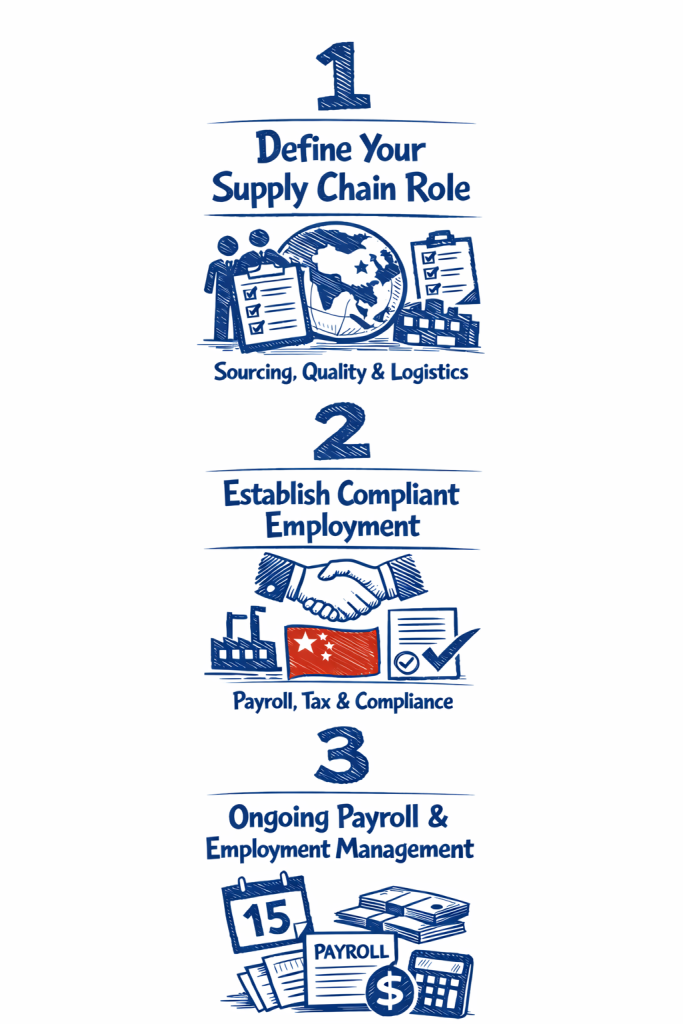
Define Your Supply Chain Role
Outline the responsibilities of your sourcing, quality, or logistics staff in China — including supplier coverage, reporting lines, and working scope — to ensure the role aligns with local employment regulations.
Establish Compliant Employment
HROne sets up a lawful employment structure under our local entity, issuing compliant contracts and preparing payroll, tax, and statutory reporting requirements in China.
Ongoing Payroll & Employment Management
While you manage day-to-day supply chain operations, we handle monthly payroll, individual income tax withholding, statutory filings, and employment administration to maintain full compliance.
Speak With a SpecialistFrequently Asked Questions
Common questions from foreign companies building supply chain teams in China to manage sourcing, quality, and logistics operations.

Can we build a supply chain team in China without setting up a company?
Yes. Through an Employer of Record (EOR), foreign companies can legally employ sourcing, quality, and logistics professionals in China without establishing a local entity.
Is it safer than hiring contractors for supply chain roles?
In many cases, yes. Supply chain roles often involve direct supervision, fixed schedules, and long-term engagement — conditions that may create contractor misclassification risk under China labor law.
Can we start with one person and expand later?
Yes. Many companies begin with a single sourcing or quality professional and gradually expand their local team as operations grow.
Who controls the day-to-day work of the supply chain staff?
You retain full operational control over supplier management, inspections, logistics coordination, and reporting.
HROne manages employment, payroll, and statutory compliance.
What if our supplier base changes?
Roles can be adjusted or redefined within a compliant employment structure. If needed, HROne can manage role transitions or replacements without disrupting operations.
Do we need compliant payroll even for a small team?
Yes. Even one local employee in China must follow payroll, tax withholding, and statutory reporting requirements.
Can we later transition the team to our own China entity?
Yes. If you establish a local entity in the future, employment can transition from the EOR structure to your own company in a structured and compliant manner.
Is this suitable for long-term supply chain presence?
Yes. Many companies use EOR as a long-term model when maintaining a light operational footprint in China while keeping local oversight.
Hear From Our Clients



Local Teams.
Structured Employment.
Stronger Supply Chains.
Years of Experience
Employees onboarded
EOR/PEO cases