

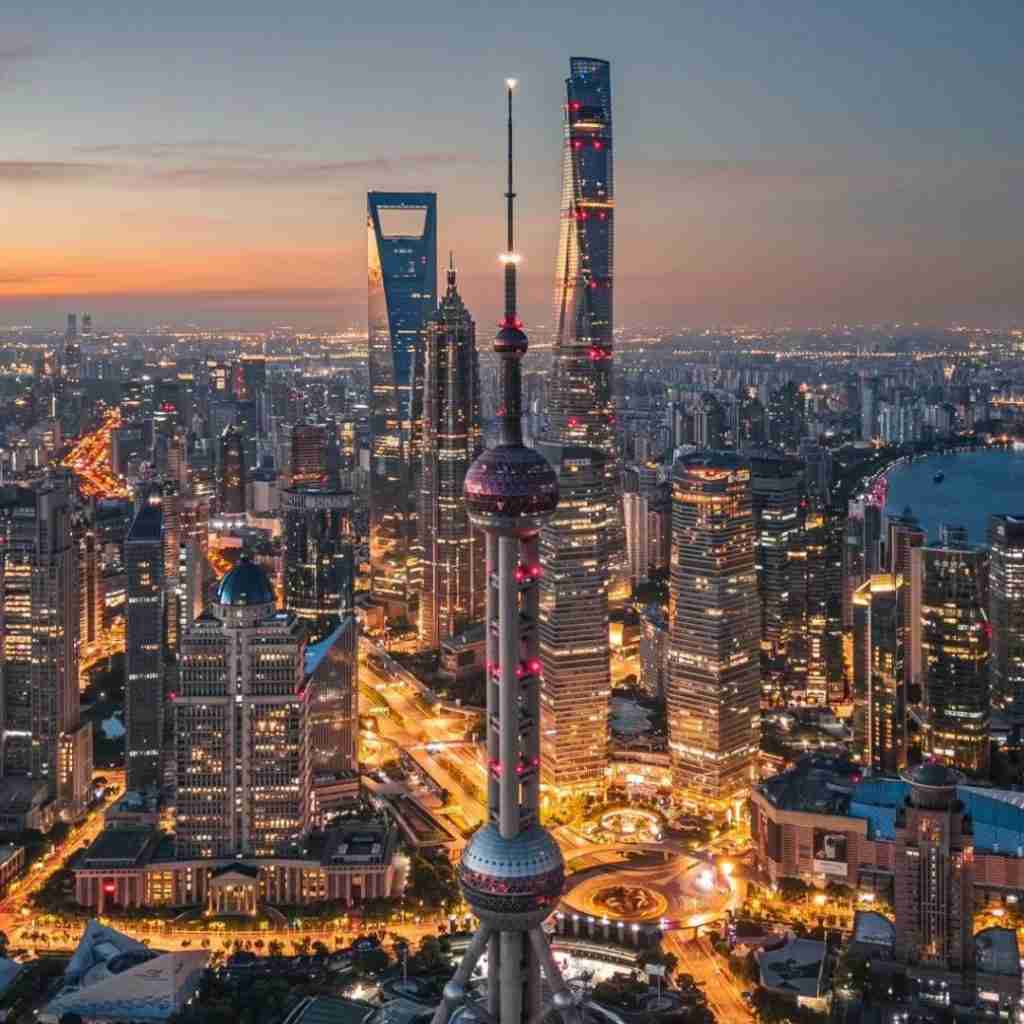
This matters for companies choosing where to hire, sell, register, source, or open operations. China’s city system affects market-entry decisions, payroll planning, social insurance contributions, local labor compliance, tax filings, government relationships, and the practical cost of managing employees across multiple locations.
How many cities are there in China?
For a simple business-facing answer, mainland China has about 694–695 administrative cities. The safest wording is “about 695,” while noting that the exact number can change when new county-level cities are established, counties are converted into districts, or administrative divisions are adjusted.
The commonly used administrative-city count includes three main city categories:
| City category | Typical count | Examples | What it means in practice |
|---|---|---|---|
| Municipalities directly under the Central Government | 4 | Beijing, Shanghai, Tianjin, Chongqing | These are province-level administrative units. They are called “cities,” but administratively they sit at the same level as provinces and autonomous regions. |
| Prefecture-level cities | 293 | Guangzhou, Shenzhen, Chengdu, Hangzhou, Suzhou, Wuhan, Xi’an | These are major city jurisdictions under provinces or autonomous regions. They often govern urban districts, counties, and sometimes county-level cities. |
| County-level cities | 397–398 depending on cut-off date | Yiwu, Kunshan, Haining, Zhangjiagang, Wenzhou’s Yueqing | These are county-level administrative units with city status. Many are economically important for manufacturing, trade, logistics, and local hiring. |
| Total administrative cities in mainland China | About 694–695 | All of the above categories combined | This is the most useful answer when discussing administrative cities, business location strategy, and HR coverage across mainland China. |
Why do different sources give different city counts?
Different numbers appear because different sources count different things. Some count only prefecture-level cities. Some include county-level cities. Some include Hong Kong and Macau as special administrative regions. Some focus on urban population instead of administrative status. Some use older administrative data.
For employers and market-entry teams, the key is to avoid treating every “city count” as if it answers the same question.
| Question being asked | Typical answer | Why the number differs |
|---|---|---|
| How many administrative cities are there in mainland China? | About 694–695 | This combines municipalities, prefecture-level cities, and county-level cities, with small changes depending on the latest administrative cut-off. |
| How many prefecture-level cities are there? | 293 | This excludes municipalities and county-level cities. It counts only one specific administrative level. |
| How many province-level divisions does China have? | 34 | This is not a city count. It refers to provinces, autonomous regions, municipalities, and special administrative regions. |
| How many cities are in China by population? | Depends on the population threshold and dataset | Population lists may count urban areas, administrative jurisdictions, metro areas, or cities above a certain population size. |
| How many Tier 1, Tier 2, or Tier 3 cities are there? | No single official answer | City tiers are business and media classifications, not formal administrative divisions. |
What counts as a city in China?
In China’s administrative system, a city is not always the same as a dense urban area. It is an administrative unit with a defined legal status. That means a Chinese city can include an urban core, suburban districts, towns, counties, industrial parks, rural land, and development zones.
What is a municipality in China?
A municipality directly under the Central Government is a province-level administrative unit. China has four: Beijing, Shanghai, Tianjin, and Chongqing. These are often internationally understood as major cities, but administratively they are much more than ordinary cities.
Chongqing is the clearest example. It is frequently described as one of the world’s largest city jurisdictions by population, but it includes a vast administrative area, not only one continuous urban core. This is why foreign readers should be careful when comparing Chinese city populations with cities in Europe, North America, or Southeast Asia.
What is a prefecture-level city?
A prefecture-level city is a second-level administrative unit under a province or autonomous region. Many of China’s best-known business locations are prefecture-level cities, including Guangzhou, Shenzhen, Chengdu, Hangzhou, Suzhou, Wuhan, Nanjing, Ningbo, Xiamen, Qingdao, and Xi’an.
In practice, a prefecture-level city may govern several urban districts and surrounding counties or county-level cities. For example, a company may say it is operating “in Suzhou,” but Suzhou’s administrative jurisdiction includes multiple districts and county-level cities such as Kunshan and Zhangjiagang, each with its own local business and employment relevance.
What is a county-level city?
A county-level city is a county-level administrative unit with city status. It usually sits below a prefecture-level city or, in some cases, is administered more directly by the province or autonomous region. County-level cities can be highly commercial, especially in manufacturing, trade, textiles, consumer goods, logistics, and cross-border sourcing.
Yiwu is a practical example for foreign companies. It is not a province-level municipality or a prefecture-level city, but it is internationally important for sourcing and trade. This shows why a smaller administrative level can still matter greatly for commercial operations and hiring strategy.
How do China’s administrative divisions work?
The State Council explanation of China’s administrative divisions describes a constitutional three-tier structure: the country is divided into provinces, autonomous regions, and municipalities; provinces and autonomous regions are divided into autonomous prefectures, counties, autonomous counties, and cities; and counties, autonomous counties, and cities are divided into townships, ethnic minority townships, and towns.
For business use, however, it is helpful to think in a practical hierarchy. This is not because every layer is a “city,” but because each layer may affect where permits are handled, where payroll is filed, where social insurance is contributed, and which local authority deals with employment issues.
| Level | Examples of units | Are these all “cities”? | Business relevance |
|---|---|---|---|
| Provincial level | Provinces, autonomous regions, municipalities, special administrative regions | No. Only the four municipalities are usually counted as cities in the mainland administrative-city count. | Important for regional policy, economic zones, broad tax and investment planning, and provincial-level strategy. |
| Prefecture level | Prefecture-level cities, autonomous prefectures, prefectures, leagues | No. Prefecture-level cities are cities, but autonomous prefectures, prefectures, and leagues are not normally counted as cities. | Often the most important level for market mapping, hiring locations, branch planning, supplier networks, and regional management. |
| County level | Districts, counties, autonomous counties, banners, county-level cities | Only county-level cities are counted as cities. Districts and counties are not normally counted as separate cities. | Very important for factory locations, trading hubs, local labor pools, housing fund and social insurance practice, and operating permits. |
| Township level | Towns, townships, ethnic townships, subdistricts | No. | Relevant for site operations, local community management, industrial parks, warehouses, and blue-collar workforce planning. |
| Village or community level | Village committees and residential committees | No. | Usually not a primary level for foreign employer planning, but may matter in local site management or land-use contexts. |
Is a Chinese city the same as an urban area?
No. A Chinese administrative city is not always the same as an urban area, metropolitan area, or built-up area. This is one of the biggest reasons international readers find China city data confusing.
When a report says a city has a very large population, it may be referring to the administrative jurisdiction rather than the continuous urban core. A prefecture-level city can include central urban districts, suburban districts, rural counties, county-level cities, industrial zones, mountains, farmland, ports, and smaller towns. This makes direct comparisons with cities in other countries difficult unless the population definition is clear.
| Term | What it usually means | Why it matters |
|---|---|---|
| Administrative city | The legally defined government jurisdiction of a municipality, prefecture-level city, or county-level city. | Useful for compliance, permits, payroll location, local filings, and government authority. |
| Urban core | The dense built-up central area most people visually recognize as the “city.” | Useful for office location, commuting, talent availability, and customer access. |
| Metropolitan area | A wider functional urban region linked by commuting, transport, housing, and economic activity. | Useful for market sizing, logistics, distribution, and regional workforce planning. |
| City tier | A business classification based on economic strength, consumption power, infrastructure, talent, and market maturity. | Useful for commercial strategy, but not a legal or administrative category. |
Are China’s city tiers official administrative divisions?
No. City tiers are not formal administrative divisions. They are commercial classifications used by media, consultants, brands, investors, recruiters, and market-entry teams. They help companies compare purchasing power, cost levels, infrastructure, talent supply, and market maturity, but they do not replace administrative status.
For example, Beijing and Shanghai are both Tier 1 cities and province-level municipalities. Guangzhou and Shenzhen are also usually treated as Tier 1 cities, but administratively they are prefecture-level cities in Guangdong Province. Hangzhou, Chengdu, Nanjing, Suzhou, Wuhan, and Xi’an are often discussed as strong Tier 2 or “new Tier 1” cities, but their legal status is still determined by China’s administrative system, not by their business tier.
| Comparison | Administrative city level | Business city tier |
|---|---|---|
| Who defines it? | Government administrative structure | Media, market researchers, businesses, and commercial datasets |
| Is it legally binding? | Yes, for administrative status and government jurisdiction | No |
| Does it affect payroll and compliance? | Yes, because local rules, contribution bases, filings, and authorities can differ by city or district | Indirectly, because tier status may affect salary expectations, talent competition, and operating costs |
| Is it stable? | Usually stable, though administrative adjustments can occur | Less stable; city tiers can change depending on methodology and market trends |
| Best use | Legal, HR, payroll, licensing, entity, and government-facing decisions | Market sizing, brand strategy, salary expectations, and expansion prioritization |
Why does the number of cities matter for foreign companies?
The number itself is not the final business insight. What matters is that China is not one single operating market. It is a large administrative and commercial landscape made up of municipalities, provincial capitals, manufacturing hubs, port cities, county-level trading centers, emerging technology clusters, and lower-cost regional labor markets.
For companies preparing to enter the Chinese market, understanding China’s city structure helps avoid common planning mistakes. A company may begin with a sales hire in Shanghai, a sourcing manager in Yiwu, a quality inspector in Dongguan, a logistics coordinator in Ningbo, and a software engineer in Chengdu. Each location can raise different questions about employment contracts, payroll administration, social insurance, housing fund contributions, local salary expectations, and management coverage.
The broader business ecosystem in China also varies by city. Manufacturing clusters, digital talent pools, e-commerce platforms, export hubs, consumer behavior, local government incentives, and operating costs differ significantly between locations. A city-count question can therefore become a market-entry question: which city or combination of cities actually fits your business model?
How should employers use China’s city structure for hiring and payroll?
Employers should use China’s administrative divisions as a practical operating map. The city where an employee works can affect local labor compliance, social insurance and housing fund practice, payroll administration, minimum wage references, public holiday operations, tax filings, and government-facing HR matters.
The right question is not only “Which city has the best talent?” It is also “Can we hire, pay, manage, and document employment compliantly in that city?”
| Employer question | Why city structure matters | Practical action |
|---|---|---|
| Where should we hire our first China employee? | Talent, salary, tax, social insurance, and management coverage differ by city. | Compare talent availability, cost, local compliance requirements, and whether the role needs to be close to customers or suppliers. |
| Can we hire in a city where we have no entity? | Employment structure matters if the company has no registered local employer in that location. | Review whether an EOR, PEO, local entity, branch, or distributor-based model is appropriate. |
| Can one China payroll setup cover multiple cities? | Payroll can be centralized operationally, but local contribution bases, filings, and benefits practice may differ. | Use a city-by-city payroll and benefits matrix rather than assuming national uniformity. |
| Should we choose a Tier 1 city or a lower-tier city? | Tier 1 cities usually offer deeper talent pools and stronger infrastructure, but lower-tier cities may offer lower costs and less hiring competition. | Match city choice to function: sales, sourcing, engineering, logistics, quality control, customer support, or back office. |
| Does administrative status affect market potential? | Sometimes. A county-level city may be commercially powerful, while a prefecture-level city may include rural areas that do not match the target market. | Look beyond the administrative label and assess industry clusters, spending power, logistics, workforce, and customer access. |
How should market-entry teams choose which Chinese cities to prioritize?
Market-entry teams should not choose cities based only on population size or brand recognition. A stronger approach is to compare city function, administrative level, industry cluster, talent market, cost structure, local compliance requirements, and the company’s first-year operating model.
A practical city-selection process includes the following steps:
- Define the business purpose. A city for sales expansion may not be the same as a city for sourcing, manufacturing, logistics, or technical hiring.
- Separate administrative city from urban market. Check whether the population or economic data refers to the whole jurisdiction or only the urban core.
- Map the talent pool. Identify whether the city has the right universities, industry clusters, language skills, commercial experience, or technical workforce.
- Check local employment costs. Salary expectations, social insurance, housing fund, and benefits practice can differ by city.
- Review government-facing requirements. Permits, filings, local tax, and HR compliance may require city-specific handling.
- Plan management coverage. Hiring employees across multiple cities requires clear reporting lines, onboarding, documentation, and communication workflows.
- Verify the latest administrative status. If exact administrative status matters, check official administrative code information through the Ministry of Civil Affairs administrative-division code page and the National Geographical Names Database referenced there.
What does urbanization tell us about China’s cities?
China’s city system should also be read together with urbanization. According to the National Bureau of Statistics 2024 communiqué, China’s permanent-resident urbanization rate reached 67.00% by the end of 2024. That means a large majority of the population now lives in urban areas, but urbanization is spread across many kinds of cities, from national hubs to regional capitals, manufacturing centers, county-level cities, and suburban districts.
For foreign employers, this supports a more nuanced strategy. China is not only Beijing, Shanghai, Guangzhou, and Shenzhen. Strong opportunities also exist in cities such as Chengdu, Hangzhou, Suzhou, Wuhan, Nanjing, Ningbo, Qingdao, Hefei, Xiamen, Xi’an, Dongguan, Foshan, Wuxi, and Yiwu. The best city depends on the role, sector, customer base, supplier network, and compliance setup.
What are the most common mistakes when reading China city data?
- Counting every administrative unit as a city. Provinces, autonomous regions, districts, counties, towns, and townships are not all cities.
- Confusing prefecture-level cities with urban cores. A prefecture-level city can include large rural and county areas.
- Using city tiers as if they were legal categories. Tier 1, Tier 2, and Tier 3 are commercial labels, not administrative divisions.
- Comparing population numbers without checking definitions. Administrative population, urban population, metro population, and built-up area population can be very different.
- Assuming all China HR rules are national-only. National labor law provides the broad framework, but city-level practice matters for payroll, benefits, minimum wage, social insurance, and filings.
- Ignoring county-level cities. Some county-level cities are highly relevant for sourcing, manufacturing, logistics, and trade.
What is the simplest way to explain China’s city count?
The simplest explanation is this: China’s city count depends on whether you are counting administrative cities, urban areas, population-ranked cities, or business tiers. For mainland administrative cities, the current practical answer is about 694–695, made up of 4 municipalities, 293 prefecture-level cities, and around 397–398 county-level cities depending on the cut-off date.
For companies, the number is only the starting point. A strong China strategy requires understanding where the city sits in the administrative hierarchy, what local rules apply, what the city is commercially known for, and how employment, payroll, tax, and management processes will operate there.
FAQ: How many cities in China
How many cities are there in China?
Mainland China has about 694–695 administrative cities, depending on the cut-off date. A 2025 Ministry of Civil Affairs response reported 694 cities, while 2026 administrative-division tracking shows 695 because the county-level city count can change.
Why do some sources say China has 694 cities and others say 695?
The difference usually comes from administrative cut-off dates. The number of municipalities and prefecture-level cities is stable at 4 and 293, but the county-level city count can change when administrative divisions are adjusted.
How many prefecture-level cities does China have?
China has 293 prefecture-level cities. These are second-level administrative units under provinces or autonomous regions and include many major business hubs such as Guangzhou, Shenzhen, Chengdu, Hangzhou, Suzhou, Wuhan, and Xi’an.
How many municipalities does China have?
China has four municipalities directly under the Central Government: Beijing, Shanghai, Tianjin, and Chongqing. These are province-level administrative units, even though they are commonly described as cities.
What is a county-level city in China?
A county-level city is a county-level administrative unit with city status. It may be governed by a prefecture-level city or administered more directly by a province or autonomous region. County-level cities can be important for manufacturing, logistics, sourcing, and local hiring.
Are Hong Kong and Macau included in the 694–695 city count?
No. The 694–695 count refers to mainland administrative cities made up of municipalities, prefecture-level cities, and county-level cities. Hong Kong and Macau are special administrative regions, not normally included in this mainland city count.
Are China’s city tiers official administrative divisions?
No. City tiers such as Tier 1, Tier 2, and Tier 3 are business classifications, not official administrative divisions. They are useful for market strategy, but they do not determine legal status, payroll rules, or government jurisdiction.

