

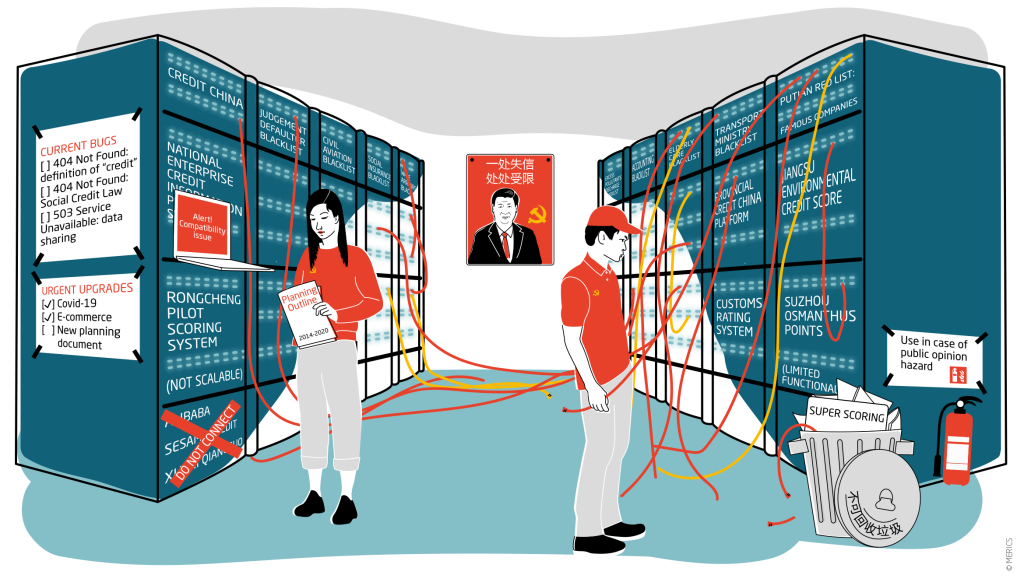
China’s social credit system is frequently described outside China as a single numerical score that monitors every individual’s daily behavior. That description is misleading.
The system is better understood as a network of public credit records, regulatory databases, sector-specific ratings, abnormal-operation lists, serious-dishonesty lists, court-enforcement records, and legally defined disciplinary measures.
For businesses, the practical concern is not a mysterious national score. It is whether tax violations, missed corporate filings, customs problems, labor-law failures, environmental penalties, licensing issues, or unresolved court judgments become visible to regulators and commercial partners.
Foreign nationals may also encounter financial credit reporting, court-enforcement systems, immigration records, tax administration, and other compliance mechanisms. However, these do not form one universal lifestyle score.
This guide explains what China’s social credit system actually does, how it affects foreign companies and individuals, what can trigger negative records, and how credit repair works.
What Is China’s Social Credit System?
China’s social credit system is a broad framework for collecting, sharing, publishing, and using certain information concerning the legal and regulatory conduct of companies, individuals, government bodies, social organizations, and other entities.
Its business purpose is to improve regulatory compliance and market trust. Information created by one authority may be made public or used by another authority when a legal basis permits it.
The system can involve:
- Business-registration records
- Administrative licenses
- Administrative penalties
- Corporate annual reports
- Tax credit classifications
- Customs classifications
- Environmental records
- Product-quality records
- Court judgments and enforcement
- Abnormal-operation lists
- Serious-dishonesty lists
- Credit commitments
- Credit-repair records
There is no single agency controlling every part of the system. Market-regulation authorities, tax bureaus, customs, courts, environmental authorities, financial regulators, labor authorities, and other agencies administer their own areas.
For that reason, the social credit system is more accurately described as a regulatory information ecosystem.
Is There One Social Credit Score for Everyone?
No national system assigns every company and person one universal numerical score covering every aspect of life.
China does have different types of credit assessments and classifications. For example, a company might simultaneously have:
- A tax credit classification
- A customs credit classification
- A market-regulation status
- Administrative penalty records
- Environmental compliance records
- Court-enforcement information
- Financial credit records
These records can produce different consequences because they belong to different regulatory systems.
A company with a strong tax record can still have a customs, employment, environmental, or licensing problem. Likewise, a favorable bank-credit assessment does not erase an unresolved administrative penalty.
Some cities and sectors have experimented with their own credit systems or points-based programs. These should not be confused with a single national score applying uniformly to every person.
How the System Works in Practice
The system generally works through five connected stages.
1. Authorities Generate Information
Government authorities generate or obtain information while performing their legal duties. Examples include registration records, licenses, inspection results, administrative penalties, and court-enforcement information.
2. Information Is Recorded or Shared
Information may be entered into an authority’s database, shared through a public credit platform, or sent to another authority where a legal basis exists.
3. Records May Be Published
Some information becomes publicly searchable. A customer, bank, supplier, investor, landlord, or potential employee may therefore see negative company information during due diligence.
4. Authorities Apply Regulatory Measures
Depending on the legal basis and severity of the conduct, authorities may increase supervision or impose specific restrictions.
5. The Subject May Seek Credit Repair
After correcting the underlying issue and satisfying the applicable conditions, a company or individual may be able to apply for repair of certain negative records.
The consequences must be connected to a defined legal or policy basis. Authorities are not meant to invent unlimited penalties for vaguely defined “bad behavior.”
The 2026 Public Credit Framework
In March 2026, the National Development and Reform Commission and the People’s Bank of China issued the 2026 editions of the National Public Credit Information Basic Catalogue and the Basic List of Disciplinary Measures for Dishonesty.
The official NDRC notice on the 2026 catalogue and measures list states that the new editions replaced the 2025 versions and remain effective for two years.
The catalogue defines which categories of public credit information authorities may collect and use. Unless another law, regulation, or central policy provides otherwise, authorities should not add information outside the applicable catalogue.
This helps place boundaries around the system. Public credit information should be legally grounded rather than based on an authority’s unrestricted judgment.
What Information Can Enter a Corporate Credit Record?
The information relevant to a foreign-invested company may come from several parts of its operations.
Corporate Registration
Registration records can include the company’s:
- Legal name
- Unified social credit code
- Legal representative
- Registered address
- Business scope
- Shareholder information
- Registration status
- Branch information
Outdated or inconsistent registration information can create problems with banks, customers, authorities, licenses, and contracts.
Annual Reports and Public Disclosures
Companies must complete required annual reporting and public disclosure.
A company may be placed on an abnormal-operation list if it:
- Fails to submit a required annual report
- Fails to disclose required information
- Publishes false information
- Cannot be contacted at its registered address
These problems are often administrative rather than fraudulent, but they can still become publicly visible.
The State Administration for Market Regulation confirms that failure to file annual information or the publication of false information can lead to abnormal status or, in serious cases, inclusion on a serious illegal and dishonest entities list.
Administrative Penalties
Administrative penalties may be issued in areas such as:
- Tax
- Customs
- Employment
- Environmental protection
- Product quality
- Advertising
- Consumer protection
- Data protection
- Workplace safety
- Licensing
A fine may not be the end of the matter. The penalty can also become a searchable public record or influence future supervision.
Court Judgments and Enforcement
Failure to satisfy an effective court judgment can lead to enforcement proceedings.
Serious court-enforcement defaults may result in legally defined restrictions applying to the company, its responsible persons, or both.
Companies should respond promptly to legal documents and enforcement notices rather than treating a commercial judgment as a private matter that has no regulatory consequences.
Sector-Specific Ratings
Tax, customs, environmental, financial, and other authorities may use classification systems within their regulatory areas.
These classifications can affect matters such as:
- Inspection frequency
- Customs processing
- Invoice controls
- Administrative convenience
- Access to certain benefits
- Regulatory monitoring
The exact consequences depend on the authority and classification.
What Is the Unified Social Credit Code?
The unified social credit code is an identifying code assigned to a registered organization.
It is not the company’s “social credit score.”
Authorities and counterparties use the code to identify the legal entity across registration, tax, banking, licensing, invoicing, and other systems. Because the same identifier connects records belonging to one company, it can make due diligence and regulatory information matching more efficient.
Foreign businesses should verify that their company name, code, address, legal representative, and operating status are accurately shown on official records.
Does the Social Credit System Apply to Foreign Companies?
Foreign-invested enterprises operating in China are generally subject to the same relevant registration, tax, customs, market-regulation, labor, environmental, and court-enforcement systems as other companies.
Foreign ownership does not provide an exemption from public disclosure or credit consequences.
A foreign company may be affected through:
- Its Chinese subsidiary
- A Chinese branch
- Its legal representative
- China-based employees
- Imports and exports
- Licenses
- Chinese customer contracts
- Administrative penalties
- Court proceedings
- An EOR, payroll, logistics, or other operating partner
An overseas company without a Chinese entity should also conduct due diligence on local partners. The compliance record of a distributor, employment provider, supplier, customs broker, or contractor can affect the foreign company’s operations and reputation.
Business Areas That Create Social Credit Risk
Corporate social credit risk usually begins with an ordinary compliance failure.
Tax and Invoicing
Late returns, inaccurate filings, false invoices, unpaid tax, or serious tax violations may affect the company’s tax record and regulatory treatment.
Finance teams should reconcile:
- Contracts
- Fapiao
- Accounting entries
- Tax returns
- Bank payments
- Cross-border remittances
HROne’s China taxation system guide explains the relationship among corporate income tax, VAT, withholding tax, payroll tax, and business structure.
Payroll and Employment
Employment problems may produce labor disputes, penalties, payment claims, or authority intervention.
Employers should maintain:
- Signed labor contracts
- Accurate payroll records
- Individual income tax filings
- Social-insurance contributions
- Housing-fund contributions
- Attendance and overtime records
- Leave records
- Termination documentation
- Foreign-employee permits
For the wider employment framework, see HROne’s China HR compliance guide.
Customs and Trade
Incorrect declarations, improper valuation, licensing failures, product-classification errors, and serious import or export violations can influence customs treatment.
Importers and exporters should verify:
- HS classification
- Customs value
- Country of origin
- Licenses
- Importer or exporter identity
- Product documentation
- Trade agreements
- Declaration records
Market Regulation
A company can develop a negative public record through basic corporate-administration failures.
Common examples include:
- Missing annual reports
- False public information
- An invalid registered address
- Expired licenses
- Misleading advertising
- Product-quality problems
- Consumer-protection violations
The legal and finance teams should maintain a corporate calendar covering every registration, license, report, and public disclosure.
Environmental and Safety Compliance
Environmental permits, emissions, waste disposal, workplace safety, and incident reporting can become part of a company’s regulatory record.
Manufacturing, logistics, chemicals, construction, energy, and other operational businesses should treat environmental and safety records as part of corporate-credit management.
Data and Cybersecurity
A serious personal-information, cybersecurity, or data-handling violation may result in penalties and reputational damage.
Companies should control:
- Employee and customer data collection
- Access permissions
- Vendor access
- Retention
- Cross-border transfers
- Cybersecurity incidents
- Required notices or consent
- Internal investigation records
Court Enforcement
Ignoring a final judgment can be more damaging than the original dispute.
Businesses should maintain a process for:
- Receiving legal documents
- Escalating claims
- Tracking judgments
- Paying or challenging obligations
- Monitoring enforcement
- Recording settlement
- Confirming case closure
Abnormal-Operation Lists
An abnormal-operation listing commonly concerns failures in corporate reporting or registration rather than the most serious forms of illegality.
A company may be listed because it:
- Did not submit its annual report
- Did not disclose required information
- Submitted false public information
- Could not be contacted through its registered address
Although these problems may be correctable, the listing can affect:
- Banking
- Customer due diligence
- Supplier onboarding
- Investment
- Licensing
- Government dealings
- Commercial reputation
A foreign parent should periodically confirm that its Chinese entity’s registered address remains valid and that official correspondence is being received.
Serious Illegal or Dishonest Lists
A serious-dishonesty listing is different from an ordinary administrative error.
Inclusion should be based on an applicable law, regulation, departmental rule, or central policy document. The responsible authority should publish the standards, procedures, removal conditions, and available remedies.
Potential consequences can include, where legally authorized:
- Public disclosure
- Closer regulatory supervision
- Restrictions on certain regulated activities
- Restrictions on particular appointments
- Limits on access to government funds or benefits
- Government-procurement or bidding consequences
- Less favorable credit assessments
- Sector-specific restrictions
These measures do not automatically apply to every violation. The authority, conduct, legal basis, severity, and list involved determine the result.
The 2026 NDRC explanation of disciplinary measures emphasizes that authorities should not impose measures outside the legally defined framework.
Does the System Apply to Foreigners Personally?
Foreign nationals can be affected by several Chinese credit and compliance systems, but they are not automatically assigned one universal social score.
Relevant areas can include:
- Bank and loan records
- Court judgments and enforcement
- Work authorization
- Residence-permit compliance
- Individual income tax
- Employment records
- Business registration
- Personal guarantees
- Administrative penalties
These systems serve different purposes.
For example, a bank’s financial-credit assessment is not the same as an immigration authority’s work-permit record. A court-enforcement restriction is not the same as a tax classification.
Foreign employees should focus on concrete obligations:
- Maintain a valid passport
- Keep work and residence permits current
- Ensure the actual employer, position, and work location match authorized arrangements
- Verify salary and tax reporting
- Retain employment and payroll records
- Respond to legal or administrative notices
- Keep banking and contact information accurate
HROne’s China work permit guide explains the work authorization and residence-permit process for foreign employees.
Does a Low Personal Score Affect a Foreigner’s Visa?
There is no single national personal social-credit score that automatically determines every foreign national’s visa or residence-permit application.
However, actual legal and administrative records can matter. Immigration authorities may consider issues such as:
- False application information
- Unauthorized work
- Overstaying
- Unresolved penalties
- Criminal conduct
- Non-compliance with permit conditions
Employers should distinguish these concrete immigration issues from the myth of a general behavioral score.
Can a Company Repair a Negative Credit Record?
Many negative credit records can be repaired if the subject meets the applicable conditions.
China’s national Credit Repair Management Measures took effect on April 1, 2026. The official credit-repair measures establish a more unified process for eligible records.
Credit repair can involve stopping the publication, sharing, or use of eligible negative information after the subject corrects the conduct and completes the required process.
Repair is not the same as pretending the violation never happened. The company must first address the underlying issue.
Credit Repair Process
A company that discovers a negative record should follow a structured process.
Identify the Exact Record
Determine:
- What information is published
- Which legal entity it belongs to
- Which authority created it
- When it was created
- Whether the information is accurate
- Which platform displays it
- Whether other authorities also use it
Determine the Classification
Find out whether the record concerns:
- An administrative penalty
- Abnormal-operation status
- A serious-dishonesty list
- Court enforcement
- Another category of public credit information
The category affects the repair route.
Correct the Underlying Conduct
Depending on the violation, correction may include:
- Filing a missing report
- Correcting false information
- Updating the registered address
- Paying tax
- Paying a penalty
- Satisfying a judgment
- Renewing a license
- Correcting an environmental or safety problem
- Completing required employee contributions
Fulfil the Required Conditions
A repair application may require:
- Completion of a minimum publicity period
- Full performance of legal obligations
- Correction evidence
- A credit commitment
- An application form
- Authority confirmation
- Other sector-specific documents
Apply Through the Correct Channel
The appropriate route may be:
- Credit China
- The authority that created the record
- A sector-specific credit platform
- A market-regulation authority
- A court-enforcement system
- Another designated portal
Some corrected records may qualify for automated repair. Others require a formal application and authority review.
Verify the Result
After approval, check whether the relevant platforms have stopped publishing or using the repaired information as required.
Maintain the repair decision and supporting documents in the company’s compliance file.
Credit-Repair Timing
Negative information can be classified by severity, affecting the relevant publicity period and repair conditions.
Under the 2026 framework, the treatment can differ among:
- Minor negative information
- General negative information
- Serious negative information
- Serious-dishonesty list information
- Records governed by separate sector rules
A company should not assume that paying a fine causes immediate removal.
The responsible team should confirm:
- Minimum publicity period
- Maximum publicity period
- Earliest application date
- Documents required
- Whether repair is available
- Whether separate platforms require action
Credit Repair Is Not a Paid Record-Deletion Service
Official credit repair is an administrative process. Companies should be cautious of private parties promising guaranteed or immediate deletion of government records.
Warning signs include:
- Guaranteed removal
- Requests for unofficial cash payments
- Claims of special authority connections
- Refusal to identify the legal repair basis
- Advice to submit false evidence
- A demand for bank passwords
- No written service scope
The national measures state that authorized institutions should not charge applicants for carrying out official credit-repair activities.
A professional adviser can assist with investigating and preparing a repair application, but the relevant authority makes the decision.
How to Check a Company’s Credit Information
Public credit information can be used for counterparty due diligence.
Two important official resources are:
Before relying on a supplier, distributor, customer, employment provider, or other partner, check:
- Registered legal name
- Unified social credit code
- Legal representative
- Registered address
- Operating status
- Business scope
- Annual-report status
- Abnormal-operation records
- Serious-dishonesty records
- Administrative penalties
- Required licenses
- Equity or registration changes
Public records are only one part of due diligence. They should be combined with financial, legal, operational, sanctions, ownership, and reputation checks appropriate to the transaction.
Counterparty Due-Diligence Warning Signs
A company should investigate further when:
- The contract name does not match the business license
- The payment account belongs to another entity
- The registered address is invalid
- The company is listed as abnormal
- Required licenses are missing
- There are repeated administrative penalties
- The company has unresolved enforcement cases
- Registered activities do not match the proposed service
- Ownership changed immediately before the transaction
- The counterparty refuses to provide official company details
These issues do not always mean that a counterparty is fraudulent, but they require explanation before the contract is signed or payment is made.
HR Compliance and Corporate Credit Risk
Employment compliance can contribute to a company’s broader regulatory profile.
Foreign employers should review:
Labor Contracts
Every eligible employee should have a compliant written contract aligned with actual working arrangements.
Payroll
Salary, bonus, overtime, deductions, individual income tax, and payslips should be accurately calculated and documented.
HROne’s China payroll guide explains the complete gross-to-net process.
Social Insurance
Employees should be registered and contributions should use the applicable city rules and contribution bases.
Housing Fund
Housing-fund registration and contributions should be administered separately from social insurance where required.
Foreign Employees
The employee’s actual job, employer, location, work permit, residence permit, payroll, and tax position should be aligned.
Employee Data
Employers should limit the collection, use, access, sharing, and retention of personal information.
Terminations
Dismissal, resignation, severance, final salary, permit cancellation, and statutory deregistration should be documented.
A company with its own Chinese entity can use China payroll outsourcing to support monthly payroll, IIT withholding, statutory contributions, payslips, and reconciliation.
Using EOR Does Not Eliminate Social Credit Risk
A China Employer of Record can provide a local employment structure where the overseas company does not have a suitable Chinese employing entity.
The EOR generally manages the labor contract, payroll, individual income tax, statutory contributions, and employment administration.
However, EOR does not automatically eliminate risks arising from:
- The client’s commercial activities
- Regulated services
- Import or export activity
- Local licensing
- Customer contracts
- Permanent-establishment exposure
- Misconduct by client managers
- Data handling
- Inaccurate payroll instructions
The EOR and client should clearly document who is responsible for every employment decision and compliance input. HROne’s China EOR guide explains that responsibility split.
Corporate Social Credit Compliance Plan
A practical internal plan should combine ongoing monitoring with clear ownership.
Monthly
- Reconcile tax, payroll, and statutory filings
- Review new administrative notices
- Confirm employee and permit changes
- Track licenses approaching expiry
- Monitor unresolved legal matters
Quarterly
- Review public company records
- Test the registered address and official correspondence process
- Review major counterparties
- Reconcile licenses with actual activities
- Escalate repeated compliance problems
Annually
- Complete the corporate annual report
- Review all entity information
- Audit payroll and social insurance
- Review tax credit and customs status
- Check environmental and safety obligations
- Review employee data controls
- Screen key suppliers and service providers
- Test the credit-repair procedure
Immediate Action Plan for Foreign Companies
Businesses concerned about social credit exposure should take the following steps.
- Search the company’s official public records using its exact Chinese legal name and unified social credit code.
- Review tax, customs, market-regulation, labor, environmental, licensing, and court-enforcement records.
- Confirm that the registered address, legal representative, business scope, and annual reports are accurate.
- Audit labor contracts, payroll, IIT, social insurance, housing fund, and foreign-employee permits.
- Identify every negative record and the authority responsible for it.
- Correct the underlying issue before applying for credit repair.
- Screen major suppliers, distributors, employment providers, and customers.
- Assign one internal owner to monitor public credit information.
- Train managers not to ignore official notices, court documents, or authority requests.
- Retain evidence showing filings, payments, correction, and compliance improvements.
Common Myths
“Everyone in China has one social credit score.”
China has multiple financial, judicial, administrative, corporate, and sector-specific systems. They are not one universal national score.
“The system only applies to Chinese-owned companies.”
Foreign-invested enterprises operating in China are subject to the relevant compliance and public-information systems.
“Only criminal conduct creates a negative record.”
Administrative failures such as missed annual reporting or an invalid registered address can also create public abnormal status.
“Paying a fine immediately removes the record.”
Payment may correct part of the violation, but publicity periods and formal repair requirements can still apply.
“Credit repair is impossible.”
Many records can be repaired after the relevant conditions are met. Some records may be excluded or governed by separate rules.
“An EOR removes all China regulatory risk.”
An EOR manages the employment relationship. It does not replace tax, licensing, customs, corporate, or commercial compliance for the client’s wider activities.
Frequently Asked Questions
What is the Chinese social credit system?
It is a framework of public credit information, regulatory records, sector classifications, abnormal-operation lists, serious-dishonesty lists, court-enforcement information, and legally defined measures.
Does every person in China receive a social credit score?
No. There is no single national numerical score that ranks every person in all areas of life.
Do foreign companies have social credit records?
Foreign-invested companies can have registration, tax, customs, administrative, court, environmental, and other relevant records in China.
What can put a company on an abnormal-operation list?
Common causes include failing to file an annual report, failing to disclose required information, submitting false public information, or being unreachable at the registered address.
Can an administrative penalty become public?
Yes. Depending on the applicable rules, administrative penalty information may be publicly disclosed or used in regulatory supervision.
Can a negative record be repaired?
Many eligible records can be repaired after the subject corrects the conduct, performs its obligations, completes any minimum publicity period, and follows the prescribed process.
Does credit repair erase the original violation?
Credit repair can stop eligible information from being published, shared, or used as negative information under the applicable rules. It does not mean the underlying event never occurred.
Does the system affect visas?
There is no universal personal score controlling visas. Actual immigration violations, false information, unauthorized work, overstaying, and other legally relevant records can affect immigration outcomes.
How can a company check a Chinese supplier?
Search the supplier’s Chinese legal name and unified social credit code through Credit China and the National Enterprise Credit Information Publicity System, then verify licenses, penalties, abnormal status, ownership, and payment details.
What should a company do after finding a negative record?
Identify the responsible authority, verify the record, correct the conduct, determine the applicable publicity period, prepare evidence, apply through the proper channel, and confirm the repair result.
Conclusion
China’s social credit system is best understood as a compliance-information and regulatory-trust framework.
It does not assign every company and foreign national one universal behavioral score. Instead, it connects specific corporate, financial, judicial, and administrative records to public disclosure, supervision, and legally authorized consequences.
For foreign companies, the most effective response is ordinary but disciplined compliance:
- File reports on time
- Maintain accurate registration information
- Pay taxes and statutory contributions correctly
- Keep licenses valid
- Respond to court and authority documents
- Maintain compliant employment records
- Screen business partners
- Correct negative records promptly
- Use the official credit-repair process
Companies that treat regulatory records as valuable business assets are better positioned to pass due diligence, maintain partner confidence, and operate reliably in China.
For help with employment structures, payroll, individual income tax, social insurance, work permits, or HR compliance, contact HROne.
This guide provides general information and does not constitute legal, regulatory, financial, immigration, or credit-repair advice. The applicable rules and consequences depend on the authority, conduct, location, and current legal framework.

