


A procurement manager salary in China should be budgeted against the role and location together. A broad national average can hide a very different mandate: managing regional supplier strategy is not the same job as supervising purchase orders at one factory. For overseas employers, China recruitment support can help translate that mandate into a local candidate brief before an offer range is approved.
For an initial 2026 comparison, the published basic monthly salary ranges are RMB 30,000–55,000 for the first-tier city group and RMB 20,000–40,000 for the second-tier group. These are grouped market references, not city-specific quotes or a guarantee that a suitable candidate will accept a particular salary.
How much do procurement managers earn in China?
| City group in the source | Basic monthly salary, RMB |
|---|---|
| First-tier cities | 30,000–55,000 |
| Second-tier cities | 20,000–40,000 |
Source: Randstad’s 2026 Chinese mainland salary guide, procurement and supply chain table, page 22. Figures exclude benefits, bonuses, commissions and subsidies. The report groups Beijing, Shanghai, Guangzhou and Shenzhen as first-tier cities; its second-tier examples include Suzhou, Hangzhou and Nanjing. The labels here follow that report.
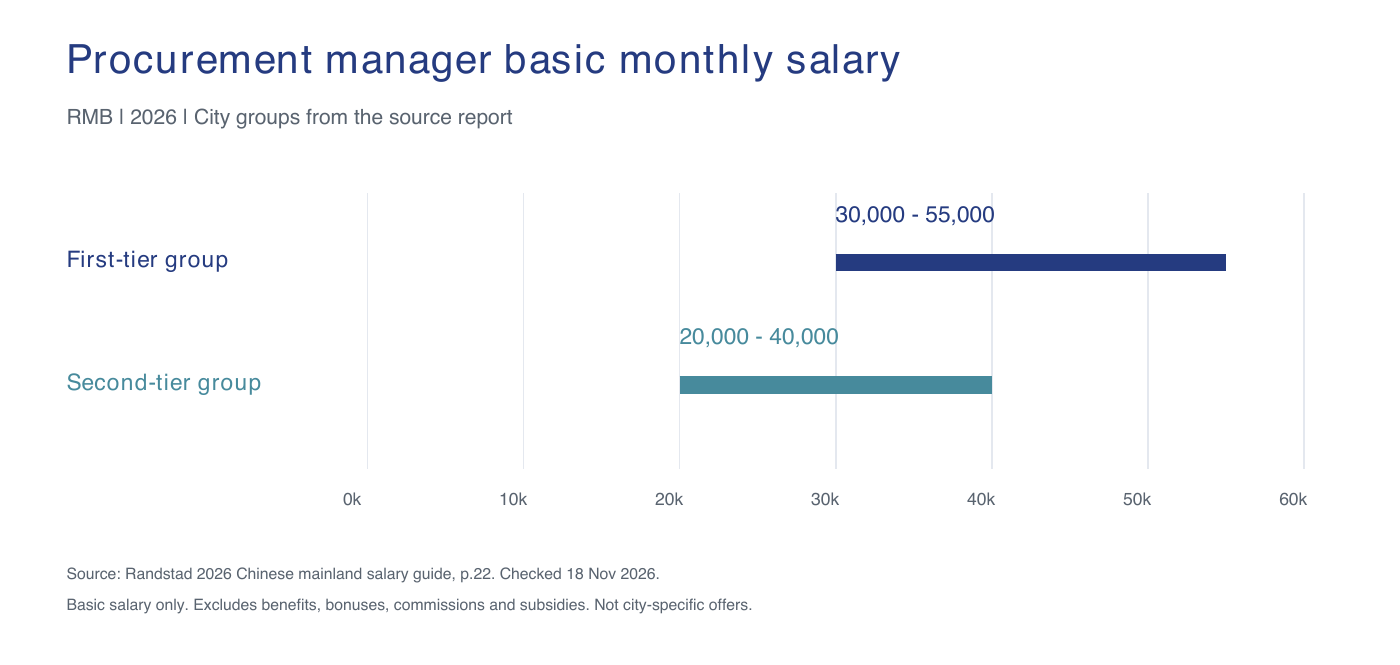
The comparison keeps one role, one source and one monthly pay measure. It does not establish an individual rate for Shanghai, Suzhou or another city. The table also does not provide a procurement-specific sample size or a matched breakdown by experience and industry. Those limits matter when deciding how closely a vacancy resembles the reference role.
What does the overlap mean for a hiring budget?
The two ranges overlap between RMB 30,000 and RMB 40,000 a month. A proposed RMB 35,000 basic salary therefore falls within both published bands. It cannot identify the correct city, prove that an offer is competitive, or show that two candidates have equivalent experience.
Consider an employer comparing a role near headquarters with one near its suppliers. Keep the responsibilities identical in both briefs, then test candidate availability and expectations separately. If one brief includes regional category leadership while the other covers daily order follow-up, the resulting salary difference mixes a location decision with a different job.
Do not turn the gap between the two lower endpoints into a promised saving. A lower published starting point does not establish what your required candidate will cost. Travel, time spent reaching suppliers, reporting responsibilities and access to specialist experience may change the practical decision even when the proposed basic salaries are similar.
Which responsibilities should the salary cover?
Write the scope before selecting a number. For a procurement manager, the most useful questions concern purchasing authority, category complexity and the outcomes the employee must deliver. A clear brief should answer:
- Will the person own supplier strategy or execute decisions made elsewhere?
- Which product or service categories must they understand?
- Will they manage people, major negotiations or several production sites?
- How often must they visit suppliers, and from which work location?
- What communication is required with headquarters, engineering, finance and quality teams?
Titles alone do not answer these questions. The distinction between procurement, purchasing and sourcing responsibilities helps establish whether the comparison matches the vacancy or whether a different benchmark is needed.
Category coverage also matters. A salary reference explicitly labeled indirect procurement manager describes a narrower role than the generic procurement-manager row. Before combining either figure with another source, check the job definition, geographic coverage and annual or monthly unit. Similar titles do not make the underlying figures interchangeable.
Why not use a city’s average wage instead?
A city average provides economic context, but it combines many workers and occupations. It does not tell you what an experienced procurement specialist with the required category knowledge will accept. HROne’s broader China salary guide separates official wage statistics from role-level planning.
The pay components also differ. The National Bureau of Statistics’ average-wage methodology includes items such as bonuses, allowances and overtime in gross wages. A basic-salary range excluding those items should not be placed beside that statistical average and described as the same measure.
Keep three labels visible in any internal comparison: what the number measures, the period it covers and the population represented. If one source gives annual compensation and another gives basic monthly pay, resolve the components before comparing them. Dividing by 12 changes the time unit; it does not remove bonuses or align the jobs.
How do you turn basic monthly pay into an annual budget?
Start with the proposed basic salary and the number of months actually budgeted. Then list additional cash payments, employer contributions and operating costs separately. The total cost of hiring in China depends on more than the headline offer, so a single nationwide uplift should not substitute for location-specific inputs.
An illustrative offer calculation
Suppose the company is considering RMB 35,000 a month for a full 12-month budget period. Basic salary would be RMB 420,000. If the company separately chooses to budget one additional month’s salary as a bonus, that assumption adds RMB 35,000, taking planned cash compensation to RMB 455,000.
This is a budgeting example, not a market bonus recommendation or a statement that every employee is entitled to a thirteenth month. The actual offer and applicable terms determine what is promised. Employer social insurance, housing fund, other benefits and any recruitment or administration charges remain outside the example.
For a fair location comparison, give each scenario its own contribution inputs and travel assumptions. Keep employee deductions separate from employer additions. Where a cost has not been verified, leave it outstanding rather than silently entering zero and presenting the total as complete.
The printable procurement hiring budget worksheet separates the published salary references from your own assumptions, with room for the location, budget period and outstanding contribution inputs.
What should you validate before approving an offer?
Give the recruiter the same brief used for the budget: location, responsibilities, reporting line, language requirements, relevant category experience and proposed package. Ask for feedback on which requirement is narrowing the available candidate pool. This makes it possible to decide whether the budget needs to change or the role needs to be redesigned.
Compare candidates on the complete proposed package and the work they would perform. Record whether an expectation refers to basic monthly salary, annual fixed compensation or a package including variable pay. A candidate’s annual target and the company’s monthly budget can appear inconsistent simply because different components are included.
Refresh the offer assumptions when the brief, work location or recruitment timing changes. A published guide is a starting reference; current conversations about a defined vacancy are the next step. Keep the source edition with the budget so a later reviewer can distinguish a market reference from an amount the company independently chose.
Frequently asked questions
Is the midpoint of the published range an average salary?
No. The midpoint is only an arithmetic point between two endpoints. Without a distribution of observations, it is not a measured mean, median or typical accepted offer.
Can I use the second-tier range as a specific Suzhou salary quote?
No. It is a city-group reference. A Suzhou vacancy still needs its own role scope and current candidate validation.
Does the comparison include bonuses and employer contributions?
The source ranges describe basic monthly salary and exclude the stated additional pay components. Build bonuses, benefits and employer contribution assumptions separately into the hiring budget.
Should we choose the location with the lower salary band?
Only after assessing the operating requirements. Supplier access, travel, team coordination and the experience needed for the role may outweigh a difference in basic salary.

