

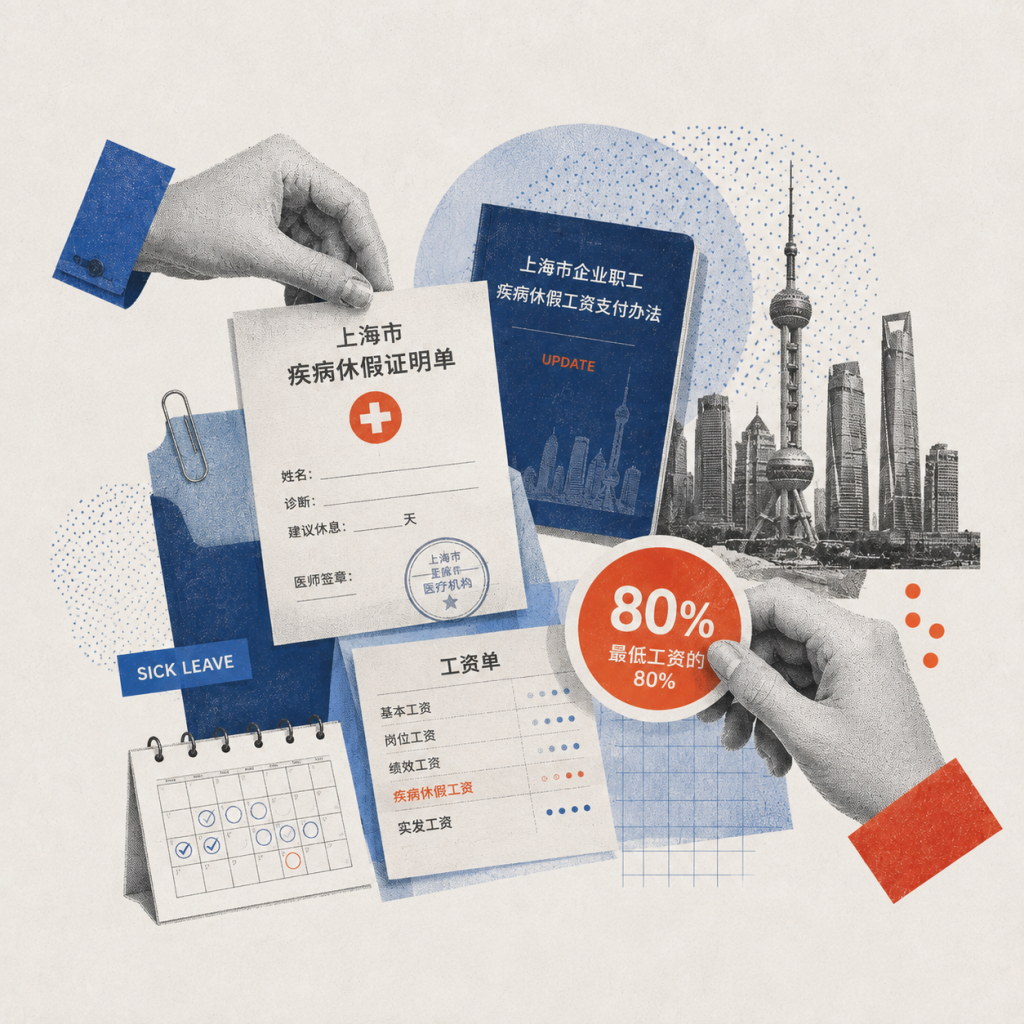
The practical position is more nuanced. National minimum protection remains in place, Shanghai has new wage-payment rules governing the calculation base for leave pay, and employment contracts, collective agreements, valid company policies, and established employment practices may all affect the amount an employer should actually pay.
For employers, HR teams, payroll managers, and foreign companies with employees in Shanghai, the key question is therefore no longer simply, “What percentage applies based on the employee’s years of service?” It is now: what valid legal, contractual, and internal policy basis determines this employee’s sick leave pay?
What changed in Shanghai’s sick leave pay rules in August 2026?
Two important Shanghai employment policy documents reached the end of their validity on August 15, 2026:
- Notice on Strengthening the Management of Employee Sick Leave and Protecting Employees’ Livelihood During Sick Leave (Hu Lao Bao Fa [1995] No. 83); and
- Notice on the Minimum Standard for Sick Leave Wages or Sickness Relief Payments for Enterprise Employees in Shanghai (Hu Lao Bao Bao Fa [2000] No. 14).
The Shanghai Municipal Human Resources and Social Security Bureau’s official normative-document register lists both documents with an expiry date of August 15, 2026.
The first document was particularly important because it contained Shanghai’s long-used service-based sick leave pay percentages. Before its expiry, employees taking sick leave for illness or a non-work-related injury for six months or less were generally paid according to the following schedule:
| Continuous Service With Employer | Former Sick Leave Pay Percentage |
|---|---|
| Less than 2 years | 60% of applicable wage basis |
| 2 years to less than 4 years | 70% |
| 4 years to less than 6 years | 80% |
| 6 years to less than 8 years | 90% |
| 8 years or more | 100% |
For continuous illness-related leave exceeding six months, the former Shanghai rules provided a different sickness-relief schedule:
| Continuous Service With Employer | Former Sickness Relief Percentage |
|---|---|
| Less than 1 year | 40% of applicable wage basis |
| 1 year to less than 3 years | 50% |
| 3 years or more | 60% |
From August 16, 2026, employers should no longer describe these percentages as the current mandatory Shanghai statutory sick leave pay formula.
They remain important historically, and the same percentages may still matter if they have been incorporated into an employment contract, collective agreement, employee handbook, company wage policy, or another binding employment arrangement. But their legal effect in that situation comes from the applicable agreement or company rule rather than simply from the expired 1995 policy itself.
Does Shanghai still require employers to pay employees during sick leave?
Yes.
The expiry of the old Shanghai percentage table did not remove the obligation to pay employees during legally recognized sick leave.
The revised Shanghai Enterprise Wage Payment Measures, effective August 1, 2026, expressly provide that employees taking statutory leave, including sick leave, must be paid leave wages in accordance with applicable rules.
The revised Measures also continue to regulate the wage base used for leave-pay calculations.
In general, the calculation base is the normal monthly wage corresponding to the employee’s position. Items such as annual bonuses, transportation subsidies, meal allowances, housing subsidies, night-shift allowances, high-temperature allowances, and overtime pay are excluded from this calculation base.
If the employment contract clearly specifies the employee’s relevant monthly wage, that amount is generally used. If the contract does not specify it but a collective agreement does, the collective agreement may determine the amount. If neither contains a clear amount, the current Shanghai Wage Payment Measures provide a fallback based on 70% of the employee’s normal monthly wage income, excluding overtime.
The calculation base itself must not be below Shanghai’s applicable minimum wage.
This means the expiry of the old service-based percentage formula should not be confused with the disappearance of Shanghai’s broader wage-payment framework.
Does the 80% minimum-wage protection still apply?
For the relevant local statutory wage floor, consult the minimum wage in China.
Yes. The national minimum protection remains relevant.
Article 59 of the Ministry of Labor’s Opinions on Several Issues Concerning the Implementation of the Labor Law, Lao Bu Fa [1995] No. 309, provides that during the statutory medical treatment period, sick leave wages or sickness relief payments may be lower than the local minimum wage but cannot be lower than 80% of the applicable local minimum wage.
Shanghai’s current monthly minimum wage is RMB 2,740.
Accordingly, the current monthly minimum sick-pay reference amount is:
RMB 2,740 × 80% = RMB 2,192
This RMB 2,192 figure is important, but employers should understand what it represents.
It is a statutory minimum protection, not automatically the standard sick leave salary for every Shanghai employee.
Can an employer simply pay RMB 2,192 per month for all sick leave?
Not necessarily.
This is probably the most important practical issue arising from the 2026 change.
The fact that RMB 2,192 represents the current minimum protection does not mean an employer may automatically replace an employee’s existing sick leave entitlement with RMB 2,192.
Before determining the amount payable, employers should review:
- the employee’s labor contract;
- any applicable collective agreement;
- the company’s employee handbook;
- the company’s compensation or sick leave policy;
- previously communicated employment benefits;
- the company’s established payroll practice; and
- the current Shanghai wage-payment rules.
For example, suppose an employee’s valid company handbook states that employees with four years of service receive 80% of their normal wage during sick leave. The expiry of the former Shanghai regulation does not necessarily eliminate that company benefit. If the handbook remains valid and applicable, the employer may still be required to follow it.
Employers should therefore be cautious about interpreting the policy expiry as permission to reduce sick leave benefits immediately.
What if the company’s handbook still contains the old 60%–100% Shanghai formula?
The answer depends on how the policy is drafted.
Scenario 1: The company policy reproduces the percentages directly
If a handbook expressly states that employees receive 60%, 70%, 80%, 90%, or 100% according to service length, those percentages may continue to operate as the company’s own sick leave benefit rules even though the underlying Shanghai policy has expired.
An employer should not assume that the policy automatically disappears merely because the original government document is no longer effective.
Scenario 2: The policy only says “sick leave pay will be calculated according to Shanghai regulations”
This creates a different issue.
If the policy does not contain an independent company formula and simply incorporates Shanghai’s applicable rules by reference, HR should review the wording carefully because the former local percentage schedule is no longer a current mandatory rule.
Scenario 3: The written policy is silent, but the company has consistently used the old formula
Past practice may also matter. A sudden reduction in a long-established compensation practice can create employee-relations and dispute risk, particularly if employees reasonably understood the treatment to form part of their employment conditions.
Before changing a sick leave policy, employers should review the adoption and consultation requirements applicable to internal employment rules. HROne’s guide to the employee handbook in China explains why rules affecting remuneration, working time, leave, and other employee interests should be properly discussed, adopted, communicated, and documented.
What should employers do if their sick leave policy needs to be changed?
Employers should avoid solving the issue through an informal payroll adjustment alone.
A sick leave policy affects both employee remuneration and leave rights. These are matters directly connected to employees’ interests and may therefore require the consultation and communication procedures applicable to company rules under China’s Labor Contract Law.
A practical policy review should include the following steps:
- Identify the current wording. Check labor contracts, handbooks, collective agreements, offer documents, payroll manuals, and HR policies.
- Identify what relies on the expired Shanghai formula. Separate statutory references from independently promised company benefits.
- Define the proposed calculation methodology. The policy should explain the wage base, calculation rate, treatment of partial-month sick leave, documentation requirements, and minimum protection.
- Check the statutory floor. The outcome should not fall below applicable minimum sick-pay protection.
- Complete the appropriate employee consultation process.
- Communicate the policy clearly. Employees should know when the new policy becomes effective.
- Update payroll configuration and records. HR policy and actual payroll treatment should match.
Companies operating their own China entities may also need to update payroll rules, calculation logic, review controls, and payslip processes. A local China payroll outsourcing provider can help ensure that HR policy changes are reflected consistently in monthly payroll calculations.
How should sick leave pay be calculated after August 15, 2026?
There is currently no single replacement Shanghai percentage table equivalent to the former 60%–100% service-based formula.
Employers should therefore use a layered approach.
| Step | Question to Check | Why It Matters |
|---|---|---|
| 1 | Is this genuine illness or non-work-related injury sick leave? | Work-related injuries follow a separate statutory regime. |
| 2 | Is the employee within the statutory medical treatment period? | The national minimum-pay protection and termination restrictions are linked to the medical treatment period. |
| 3 | What is the applicable leave-pay calculation base? | The 2026 Shanghai Wage Payment Measures continue to regulate the calculation base. |
| 4 | Does the labor contract or collective agreement specify sick leave treatment? | Contractual commitments may remain binding. |
| 5 | Does a valid employee handbook or wage policy specify a percentage? | Company rules may create an entitlement above the statutory minimum. |
| 6 | What has the employer historically paid? | Established practice can affect dispute risk and employee expectations. |
| 7 | Does the final result satisfy the applicable statutory floor? | The current full-month reference floor in Shanghai is RMB 2,192. |
The result should therefore be based on the complete employment framework rather than a single percentage copied from an expired regulation.
Does the 2026 change affect Shanghai’s statutory medical treatment period?
No. Sick leave pay and the statutory medical treatment period are related but legally distinct concepts.
Sick leave concerns the employee’s absence and the wages payable during that absence.
The statutory medical treatment period is a protected employment period during which an employee who is ill or suffers a non-work-related injury receives specific employment protections, including restrictions on certain employer-initiated termination routes.
Shanghai continues to apply a local medical treatment period based on the employee’s continuous service with the current employer. Under current Shanghai HRSS guidance, the employee receives three months of medical treatment period during the first year of employment. The entitlement then increases by one month for each subsequent completed year of service, up to a maximum of 24 months.
Employers should therefore continue tracking medical treatment periods even if they revise the sick leave pay calculation methodology.
For a broader explanation of the distinction, see HROne’s China sick leave and medical treatment period guide.
What happens if an employee’s sick leave started before August 15, 2026?
This is one of the more difficult practical questions because the published expiry information does not establish a detailed transitional sick-pay formula for leave that spans the expiry date.
Employers should therefore avoid automatically recalculating previously accrued or approved sick leave benefits retroactively.
For an employee whose absence began before August 16 and continues after that date, HR should review:
- when the relevant sick leave entitlement arose;
- what policy was communicated to the employee;
- whether sick leave had already been approved;
- how payroll was calculated before August 16;
- the wording of the employment contract and handbook; and
- whether changing the calculation partway through the absence would reduce an established employee benefit.
Until clearer local implementing guidance is available, a conservative approach is generally preferable to a sudden retroactive reduction.
What does this mean for foreign companies using an EOR in Shanghai?
For companies without a Chinese legal entity, the overseas company may direct the employee’s daily work while an EOR acts as the local legal employer.
In that structure, formal employment matters such as the labor contract, payroll, statutory benefits, sick leave administration, and employment-policy implementation need to be coordinated through the legal employer.
A client should therefore avoid independently promising, reducing, or changing a Shanghai employee’s sick leave pay without first coordinating with its EOR.
Companies hiring through a China Employer of Record should notify the EOR when an employee enters an extended sick leave or medical treatment period so that payroll, employee documentation, medical certificates, and employment protections can be reviewed together.
What should Shanghai employers do now?
The immediate compliance priority is not to redesign sick leave benefits overnight. It is to identify which parts of the company’s current practice were based on the expired Shanghai rules and which parts are independently supported by employment contracts, policies, or established company practice.
Employers should review sick leave policies, payroll formulas, employee handbooks, employment contracts, and current long-term sick leave cases. HR and payroll teams should also ensure they are using the 2026 Shanghai Wage Payment Measures rather than outdated versions when determining the leave-pay calculation base.
Most importantly, employers should not treat RMB 2,192 as a universal replacement salary. It is the current minimum sick-pay reference amount based on 80% of Shanghai’s RMB 2,740 monthly minimum wage. The employee’s actual entitlement may be higher.
The 2026 change therefore gives employers greater need for a clearly documented company methodology, but it does not remove sick leave wage protection.
FAQ
Did Shanghai abolish sick leave pay in 2026?
No. The old Shanghai documents governing the service-based sick leave pay formula expired on August 15, 2026, but employers must still pay employees during qualifying sick leave in accordance with applicable national rules, current Shanghai wage-payment rules, employment contracts, and valid company policies.
Is the old 60%, 70%, 80%, 90%, and 100% formula still mandatory?
It should no longer be treated as a current mandatory Shanghai statutory formula from August 16, 2026 merely because it appeared in Hu Lao Bao Fa [1995] No. 83. However, the same percentages may continue to apply if they are independently incorporated into a valid labor contract, collective agreement, employee handbook, or company policy.
What is the minimum sick leave pay in Shanghai in 2026?
Shanghai’s monthly minimum wage is currently RMB 2,740. The national minimum sick-pay protection is 80% of the local minimum wage, producing a current full-month reference amount of RMB 2,192.
Can an employer reduce sick leave pay to RMB 2,192?
Not automatically. RMB 2,192 is a minimum protection rather than a universal sick leave salary. Employers must first review employment contracts, collective agreements, internal policies, established practice, and the applicable calculation base.
Did Shanghai’s medical treatment period expire as well?
No. The statutory medical treatment period remains in force. Shanghai continues to determine it based primarily on the employee’s service with the current employer, starting at three months in the first year and increasing with service up to a maximum of 24 months.
Should employers immediately rewrite their sick leave policies?
Employers should review them immediately, but changes should not be made informally. If the policy affects employee remuneration or leave rights, the employer should assess applicable employee consultation and communication requirements before implementing a new rule.
What if an employee was already on sick leave on August 15, 2026?
There is no detailed published transitional calculation formula addressing every cross-over case. Employers should review the employee’s existing entitlement, policy wording, prior payroll treatment, and the timing of the leave before changing the calculation. Retroactive reductions should be approached cautiously.
This article is intended for general informational purposes and does not constitute legal advice. Employers handling individual long-term sickness, medical treatment period, termination, or policy-change cases should assess the employee’s specific facts and applicable employment documents.

