

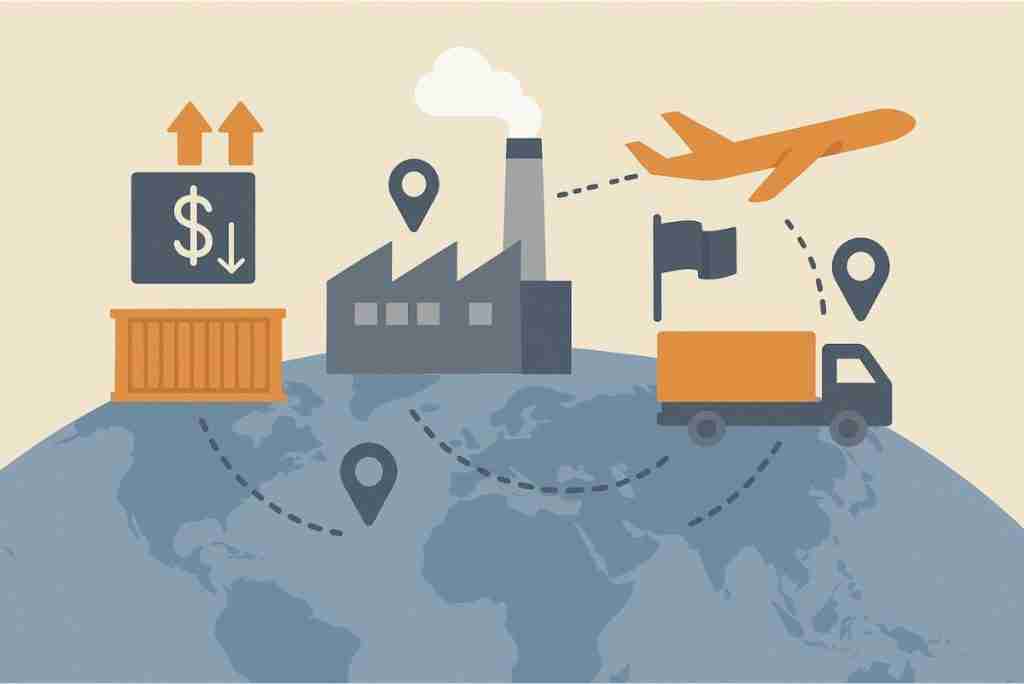
Headlines about companies leaving China often suggest a broad corporate exodus. The reality is more nuanced.
Some businesses are moving selected production lines, redirecting new investment or adding suppliers in Southeast Asia, India, Mexico and other markets. Many are simultaneously retaining Chinese suppliers, engineering support, quality-control teams or access to China’s domestic market.
This is better described as supply chain diversification—or a China+1 strategy—than a complete departure.
For business leaders, the useful question is not simply whether to leave China. It is:
Which functions should move, which should remain, and what local workforce is still required?
Are Companies Really Leaving China?
Some companies are reducing their exposure. This is particularly visible in tariff-sensitive manufacturing, lower-margin assembly and industries affected by export controls or customer-origin requirements.
However, current investment data does not support the idea that foreign businesses are abandoning China as a group.
UN Trade and Development reported that China remained one of the world’s largest foreign-investment recipients in 2025. Inflows declined from approximately $116 billion to $105 billion, while the country continued attracting commitments in research, pharmaceuticals and higher-value activities. See UNCTAD’s 2026 developing-Asia investment analysis.
China’s Ministry of Commerce also reported that 24,018 new foreign-invested enterprises were established during the first five months of 2025, an increase of 10.4% year on year. At the same time, utilised FDI declined by 13.2%. The MOFCOM data therefore points to continued market entry combined with more selective capital deployment.
The pattern is recalibration, not a uniform exit.
Why Are Companies Diversifying Beyond China?
Companies rarely restructure for only one reason. The decision normally reflects several connected pressures.
1. Tariffs and trade policy
Tariffs can make China-based production less competitive for particular destination markets.
Companies may move final assembly or qualifying production stages elsewhere to reduce duty exposure. This requires careful analysis of customs classification, transformation requirements and rules of origin.
Moving a final assembly step does not necessarily remove Chinese components from the product or change its origin legally.
2. Geopolitical and export-control risk
Trade restrictions, sanctions, investment screening and export controls have become board-level concerns.
This is particularly important for businesses working with:
- Semiconductors
- Advanced computing
- Telecommunications
- Critical minerals
- Aerospace
- Defence-adjacent products
- Sensitive technology
- Large volumes of regulated data
Diversification can reduce dependence on one political or regulatory relationship, although it may create new compliance obligations elsewhere.
3. Supplier concentration
Relying on one supplier, industrial cluster or country creates disruption risk.
Companies may qualify secondary suppliers even when the original Chinese supplier remains competitive. The aim is to create redundancy rather than replace the entire network.
4. Cost pressure
Labor, rent and compliance costs have increased in some Chinese locations.
However, wage comparisons alone are unreliable. A lower-cost country may also create:
- Higher defect rates
- Longer lead times
- Additional inventory
- Training expenses
- Tooling duplication
- Lower productivity
- Management travel
- More complex logistics
Businesses should calculate total landed cost instead of comparing hourly wages.
5. Customer requirements
Major customers increasingly request regional sourcing, local content, supply-chain transparency or production outside particular countries.
Diversification may therefore be driven by contract conditions rather than the manufacturer’s preferred operating model.
6. Operational resilience
Pandemic disruption, port congestion, shipping shocks and component shortages exposed the risks of concentrated supply chains.
A diversified network can provide alternative factories, transport routes and supplier capacity when one location becomes unavailable.
What Is a China+1 Strategy?
China+1 means retaining China as part of the supply chain while developing at least one additional production, sourcing or operational location.
A company might:
- Keep components and tooling in China
- Move final assembly to Vietnam or Mexico
- Retain China-based procurement specialists
- Add suppliers in India or Thailand
- Manufacture separately for different customer regions
- Keep production in China for the domestic market
- Retain engineering and QA/QC near Chinese suppliers
The strategy is designed to reduce concentration risk without discarding useful China capabilities.
This approach reflects wider global investment patterns. UNCTAD reports that investment flows are increasingly concentrated in strategic sectors and that the 2026 outlook remains affected by trade uncertainty and economic fragmentation. See the World Investment Report 2026 summary.
Why China Remains Difficult to Replace
China remains deeply integrated into global trade.
According to the World Trade Organization’s China profile, China exported approximately $3.58 trillion in goods during 2024.
Its continuing supply-chain advantages include:
- Dense supplier networks
- Established manufacturing clusters
- Tooling and prototyping capability
- Technical and engineering talent
- Large-scale production capacity
- Developed ports and logistics infrastructure
- Experience with complex quality requirements
- A substantial domestic customer market
Alternative locations may compete successfully in particular industries. Few can immediately reproduce every part of China’s industrial ecosystem.
What Companies Commonly Move
The most practical candidates for diversification are functions with significant exposure and manageable switching costs.
These may include:
- Tariff-sensitive final assembly
- Labor-intensive production
- Secondary component sourcing
- Regional packaging and fulfilment
- Products subject to customer-origin restrictions
- Simple components with limited tooling requirements
Companies should pilot a new supplier or production line before transferring major volumes.
The pilot should test quality, throughput, delivery performance, workforce stability, compliance and the true cost of management.
What Companies Often Keep in China
Even after moving production elsewhere, companies frequently retain functions that depend on local supplier access and technical knowledge.
Common retained roles include:
- Procurement Manager
- Sourcing Manager
- Supplier Quality Engineer
- QA/QC Inspector
- Logistics Coordinator
- Tooling Engineer
- Product-development Engineer
- China Sales Manager
- Technical-support Specialist
- Supplier-transition Project Manager
These employees can preserve supplier relationships, investigate quality issues and coordinate components moving between China and new production locations.
HROne’s supply-chain hiring solution supports companies building or retaining these local capabilities. Businesses can also hire dedicated sourcing managers, QA and QC engineers in China and logistics staff.
How EOR Supports a Lean China Team
A company may decide that it no longer needs a large Chinese entity but still requires several employees to manage suppliers, quality or customers.
A China Employer of Record can provide a local employment structure for suitable roles. The EOR’s Chinese entity normally signs the employment contract, runs payroll, withholds individual income tax and administers statutory benefits.
The client continues managing the employee’s daily responsibilities.
EOR may be useful when a company is:
- Retaining key staff after downsizing
- Closing an entity but preserving local capability
- Testing new Chinese suppliers
- Hiring its first sourcing or QA/QC employee
- Operating a temporary transition project
- Maintaining a small China sales or support team
- Waiting for a new entity to become operational
The complete China EOR guide explains the responsibility split and situations in which the model may be appropriate.
EOR solves the employment layer. It does not authorise the foreign company to issue Chinese invoices, hold regulated licences, import or export in its own name, or conduct unrestricted commercial activity.
When Should a Company Keep Its Chinese Entity?
Before withdrawing funds or restructuring, distinguish capital-return procedures from repatriating profits from China.
Closing an entity is not automatically the right response to supply-chain diversification.
A local company may remain necessary when the business needs to:
- Issue local fapiao
- Receive customer revenue in China
- Hold industry licences
- Sign local operating contracts
- Import, export or hold inventory
- Employ a large permanent team
- Own important local assets
- Manufacture or perform regulated activities
Use HROne’s China market entry guide to compare a local entity, EOR, distributor and other operating models.
Managing Employees During Restructuring
Supply-chain restructuring is also an employment project.
Employees may be transferred, retained, terminated or moved to a different employing structure. Each action should be reviewed before it is announced.
The process may involve:
- Business and workforce planning
- Selection criteria
- Employee consultation or communication
- Contract amendments
- Mutual termination agreements
- Statutory severance
- Final salary and bonus calculations
- Unused annual leave
- Social-insurance and housing-fund changes
- Confidentiality and intellectual-property protection
- Transfer of personnel records
- Work-permit changes for foreign employees
China is not an at-will employment jurisdiction. A commercial decision to reduce operations does not by itself provide a complete termination procedure.
Companies closing an entity but retaining essential employees should review HROne’s team-retention solution after entity closure.
Businesses keeping their entity but reducing internal HR capacity can use China payroll outsourcing to support payroll, IIT and statutory-benefit administration.
Supply Chain Diversification Checklist
Before moving production or closing a China operation:
- Map suppliers, components, tooling and China revenue.
- Identify functions that genuinely create concentration risk.
- Calculate total landed cost.
- Check customs classifications and origin rules.
- Pilot alternative suppliers before moving volume.
- Document quality and production standards.
- Decide which China capabilities must remain.
- Identify employees with critical knowledge.
- Select the correct employment model.
- Plan transfers and terminations before communicating them.
- Confirm whether a Chinese entity is still required.
- Review the structure annually.
Common Diversification Mistakes
Avoid:
- Treating “leave China” as a complete strategy
- Moving production based only on wage costs
- Closing the entity before planning employee retention
- Losing supplier and tooling knowledge
- Assuming a new supplier is ready without testing
- Using contractors for employee-like China roles
- Ignoring customs and rules-of-origin requirements
- Expecting EOR to replace operating licences
- Removing local quality oversight too early
Final Takeaway
Some businesses are reducing their China exposure, but many are redesigning rather than abandoning their China operations.
The strongest strategy is usually function-specific. Diversify where concentration creates unacceptable risk, but retain the suppliers, employees and technical capabilities that continue to create value.
For many companies, this results in a smaller but strategically important China team.
HROne can help businesses recruit, retain, employ and pay China-based employees during supply-chain restructuring. Contact HROne to discuss the appropriate workforce structure.
This article provides general information and does not constitute legal, tax, customs or investment advice.
Frequently Asked Questions
Are foreign companies leaving China?
Some companies are moving selected production or investment. Many continue operating in China while adding capacity elsewhere.
What is China+1?
China+1 is a strategy in which a company keeps China in its supply chain while adding at least one other production or sourcing location.
Which operations commonly remain in China?
Procurement, supplier management, quality control, engineering, tooling, logistics and China sales frequently remain because they depend on local knowledge and relationships.
Can EOR help after a company closes its China entity?
Potentially. An EOR may employ selected workers through a local structure, subject to reviewing the roles, location, transition procedure and wider activities.
Does EOR allow a foreign company to trade in China?
No. EOR supports employment. It does not automatically provide licences, local invoicing or authority to conduct regulated commercial operations.
Should a company close its entity after moving production?
Not necessarily. A local entity may still be required for China revenue, invoicing, licences, contracts, inventory or a substantial workforce.

