

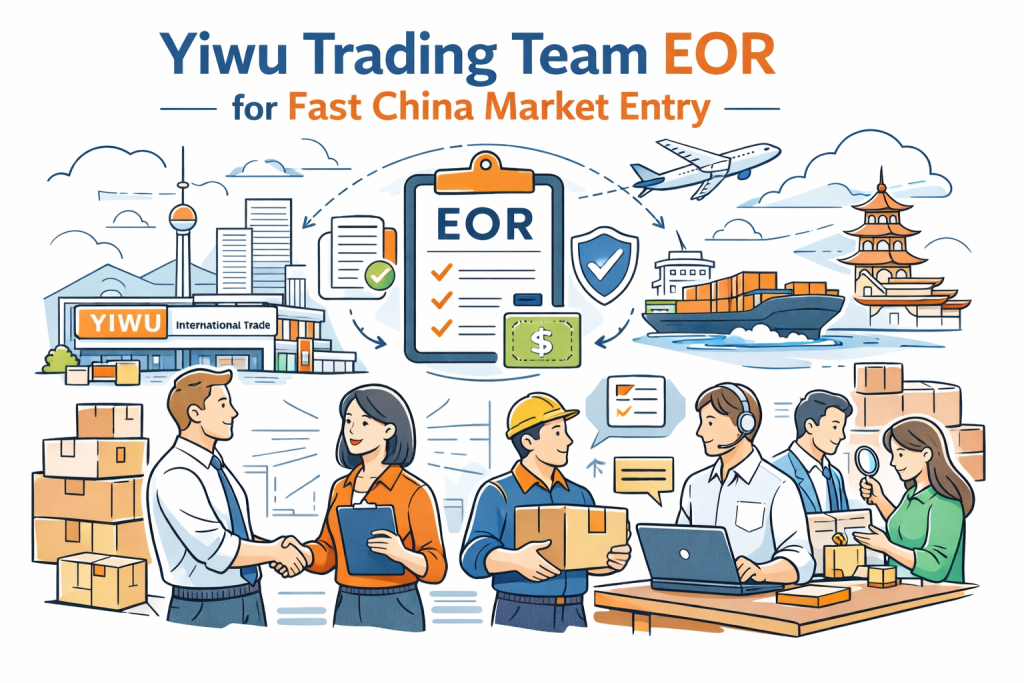
Foreign buyers sourcing consumer goods in Yiwu often need local employees to inspect samples, coordinate supplier orders and follow up on shipping documents. When those roles are suitable for local employment but the buyer has no Chinese employing entity, a China Employer of Record can administer the employment contract and statutory payroll. It does not become the buyer’s importer, licensed exporter or Chinese VAT invoice issuer.
For foreign companies sourcing products from China, having a local trading team can provide significant advantages. Local employees can help identify suppliers, communicate with factories, manage quality checks, coordinate shipments, and support supplier relationships.
However, hiring employees in Yiwu can create challenges for companies without a legal entity in China. Employers must manage employment contracts, payroll, Individual Income Tax (IIT), social insurance contributions, and local compliance requirements.
The decision is therefore whether the proposed sourcing job can be employed locally through an EOR, and separately which entity will purchase, export, invoice and contract for the goods.
What Is a Yiwu Trading Team EOR?
A Yiwu Trading Team Employer of Record (EOR) allows a foreign company to hire employees in Yiwu while the EOR provider acts as the legal employer.
The foreign company maintains control over daily work activities, responsibilities, and business objectives, while the EOR manages employment administration and compliance requirements.
An EOR typically handles:
- Employment contracts.
- Payroll processing.
- Individual Income Tax (IIT) withholding.
- Social insurance administration.
- Employee onboarding.
- Employment compliance support.
For companies entering China without a local entity, an EOR can significantly reduce the time and complexity involved in building a local team.
Learn more about the broader model in HROne’s China Employer of Record Guide.
Why Build a Trading Team in Yiwu?
Yiwu has a distinct sourcing ecosystem rather than merely being another Chinese city name. According to the Yiwu Commerce Bureau’s December 2025 economic briefing, January–November 2025 imports and exports reached RMB 770.386 billion. Yiwu Customs figures published in January 2026 put the full-year 2025 trade total at RMB 836.5 billion. The city’s market-procurement export channels make supplier verification, product sampling, order documentation, quality control and shipment coordination particularly relevant roles for overseas buyers.
Yiwu has become a major international sourcing destination because of its extensive supplier network, wholesale markets, and manufacturing connections.
A local Yiwu trading team can help foreign businesses:
- Identify reliable suppliers.
- Communicate with Chinese manufacturers.
- Negotiate pricing and contracts.
- Monitor product quality.
- Coordinate logistics and shipments.
- Understand local market conditions.
Having employees based locally allows companies to build stronger supplier relationships and respond faster to changes in the market.
Why Hiring a Yiwu Team Can Be Challenging
Although Yiwu provides significant business opportunities, hiring local employees requires companies to understand China’s employment framework.
Common challenges include:
- No existing Chinese legal entity.
- Understanding local employment regulations.
- Managing payroll and statutory benefits.
- Handling employment documentation.
- Maintaining compliance with changing regulations.
For many smaller companies and international businesses testing the market, establishing a full legal entity may require significant time and investment.
Benefits of Using an EOR for a Yiwu Trading Team
For foreign companies building sourcing or trading operations in Yiwu, an Employer of Record provides a flexible way to hire local talent while avoiding the complexity of establishing a Chinese legal entity.
The main benefits include:
1. Faster Market Entry
Establishing a legal entity in China can involve significant preparation, registration procedures, and ongoing administrative responsibilities. An EOR allows companies to hire employees more quickly while they evaluate business opportunities in Yiwu.
This approach is particularly useful for companies that want to:
- Test the Yiwu market before making a long-term investment.
- Build a small sourcing team first.
- Start operations without entity setup delays.
2. Hire Local Talent Without a China Entity
Finding experienced local professionals is often easier when companies can hire employees directly in the market where they operate. However, foreign businesses without a Chinese entity may not have a compliant way to employ those workers.
An EOR solves this challenge by becoming the legal employer while allowing the foreign company to manage the employee’s daily responsibilities.
3. Simplified Payroll and Benefits Management
Managing payroll in China requires understanding salary calculations, Individual Income Tax (IIT), social insurance contributions, and local employment requirements.
Through an EOR arrangement, payroll responsibilities are handled by local specialists who understand Chinese employment requirements.
Typical support includes:
- Monthly salary processing.
- Tax withholding administration.
- Social insurance management.
- Employment documentation.
- Payroll reporting.
If the buyer already has its own Chinese employing entity, outsourcing the local payroll process may be more suitable than EOR employment, because the client entity can retain direct employer status while using specialist support for salary, IIT and statutory contributions.
4. Maintain Compliance With Chinese Employment Regulations
China’s employment regulations require employers to manage contracts, payroll, statutory benefits, and employee records correctly.
An EOR helps foreign companies reduce compliance risks by managing employment administration according to local requirements.
This includes:
- Compliant employment contracts.
- Employee onboarding.
- Payroll administration.
- Statutory contribution management.
- Employment record keeping.
5. Build Supplier Relationships Through Local Employees
A local Yiwu trading team provides valuable market knowledge that cannot always be achieved remotely. Employees familiar with local suppliers, language, and business practices can help companies build stronger partnerships.
A Yiwu-based team can support:
- Supplier communication.
- Product sourcing.
- Factory coordination.
- Quality control activities.
- Market research.
- Logistics coordination.
6. Scale the Team as Business Needs Change
Business needs can change quickly, especially for companies sourcing products or testing new markets. An EOR allows businesses to adjust their workforce strategy without immediately committing to the cost and complexity of establishing a local entity.
Companies can start with a small team and expand as opportunities develop.
Common Roles in a Yiwu Trading Team
The structure of a Yiwu team depends on the products and whether the staff will coordinate or legally bind the business. China recruitment support can help assess the language skills, supplier experience and quality-control competencies required for the following roles:
| Role | Responsibilities |
|---|---|
| Sourcing Specialist | Identifies suppliers and evaluates product opportunities. |
| Buyer / Purchasing Manager | Manages supplier negotiations and purchasing activities. |
| Quality Control Specialist | Coordinates inspections and ensures product standards. |
| Supply Chain Coordinator | Manages logistics, shipments, and supplier timelines. |
| Trading Representative | Supports communication between international buyers and Chinese suppliers. |
Yiwu Trading Team EOR vs. Setting Up a China Entity
An EOR is an employing entity, not a trade license. Zhejiang’s official explanation of Yiwu market-procurement trade describes special customs and tax processes for eligible trading operators. An EOR employee can potentially support supplier liaison, inspections and logistics documentation, but the relevant buyer, exporter and trade operator must independently confirm their contracts, customs registration, VAT/fapiao treatment, export permissions and foreign-exchange procedures. The EOR’s labor contract does not authorize the client to claim those trade privileges.
When a team needs licensed export execution, local invoicing, warehousing or a sustained China trading business, a Chinese operating entity or another properly authorized commercial partner may be required. Define those responsibilities before employing a buyer or sourcing representative.
Before building a local team, companies should evaluate whether establishing a Chinese entity or using an EOR better fits their expansion plans.
| Factor | EOR | China Entity |
|---|---|---|
| Setup speed | Fast | Longer setup process |
| Legal entity required | No | Yes |
| Initial investment | Lower | Higher |
| Operational control | Managed through service agreement | Direct ownership |
| Best for | Market testing and flexible hiring | Long-term operations |
Companies planning significant long-term operations may eventually establish their own entity, while businesses testing opportunities in Yiwu often benefit from the flexibility of an EOR model.
How to Build a Yiwu Trading Team With an EOR
Building a successful Yiwu trading team requires more than hiring employees. Companies need to define their business objectives, identify the right roles, establish compliant employment arrangements, and create effective processes for managing local operations.
Before recruiting, compare a sourcing agent vs in-house team to decide how much direct supplier control and daily staffing your operation needs.
An EOR-supported hiring process typically follows several key steps:
Step 1: Define Your China Business Objectives
Before hiring a local team, companies should determine what they want to achieve in Yiwu.
Common objectives include:
- Finding new suppliers.
- Reducing sourcing costs.
- Improving supplier communication.
- Managing product quality.
- Expanding product categories.
- Supporting international sales operations.
A clear strategy helps businesses determine which roles and expertise are required.
Step 2: Identify Required Team Roles
The structure of a Yiwu trading team depends on the company’s products and operational needs. Some businesses may only require a sourcing specialist, while others may need a larger team covering procurement, quality control, and logistics.
Employers should consider:
- The number of suppliers being managed.
- The complexity of products.
- Required language capabilities.
- Quality control requirements.
- Expected order volume.
Step 3: Hire Employees Through a Compliant Structure
Once roles are defined, businesses must choose an appropriate employment structure. Foreign companies without a China entity cannot typically employ local staff directly.
An EOR allows companies to:
- Hire Yiwu-based employees legally.
- Issue compliant employment contracts.
- Process payroll.
- Manage statutory benefits.
- Support ongoing HR administration.
This enables businesses to focus on managing their trading operations while the EOR handles employment compliance.
Step 4: Manage the Team and Measure Performance
After hiring, companies should establish clear communication channels, responsibilities, and performance expectations.
Useful performance indicators may include:
- Number of qualified suppliers identified.
- Supplier response times.
- Cost savings achieved.
- Product quality performance.
- Order completion rates.
- Supply chain improvements.
Employer Responsibilities When Using an EOR
Although the EOR manages employment administration, the client company continues to manage the employee’s day-to-day work and business activities.
The client company typically remains responsible for:
- Assigning work responsibilities.
- Managing daily performance.
- Providing business direction.
- Setting operational goals.
- Communicating with employees regularly.
The EOR manages the employment relationship from a legal and administrative perspective, while the company manages the commercial relationship.
Payroll and Compliance Considerations for Yiwu Employees
2026 Yiwu minimum wage: The Jinhua municipal government’s March 2026 notice sets Yiwu’s minimum monthly wage at RMB 2,430 and statutory non-full-time hourly minimum at RMB 23, effective January 1, 2026. These are statutory floors, not sourcing-specialist salary benchmarks.
2026 Zhejiang social-insurance base: The provincial five-department notice Zhe Ren She Fa [2026] No. 52, published October 8, 2026, sets the annual employee social-insurance contribution-base range at RMB 5,122–25,611 per month, based on the 2025 province-wide weighted average wage. Refer to the provincial notice and verify the exact contribution type, city procedure and effective assessment period with payroll before quoting an employee’s monthly cost. A minimum wage and an insurance contribution floor are different figures.
Employers hiring Yiwu-based employees must consider several payroll and compliance requirements, including:
- Employment contracts.
- Monthly salary payments.
- Individual Income Tax (IIT) withholding.
- Social insurance contributions.
- Employee records.
- Local employment regulations.
These requirements can create administrative challenges for companies unfamiliar with China’s employment system.
For businesses that already have a China entity and only require payroll assistance, HROne also provides China Payroll Outsourcing Services.
When Should Companies Use Yiwu Trading Team EOR?
A Yiwu Trading Team EOR solution is particularly useful for companies that want to establish local capabilities without immediately creating a Chinese subsidiary.
This approach may be suitable when a company:
- Wants to test Yiwu sourcing opportunities.
- Needs local employees quickly.
- Plans to build a small China team first.
- Does not want the cost of entity establishment.
- Needs support managing employment compliance.
How HROne Supports Yiwu Trading Teams
Building a China-based trading operation requires local talent, reliable employment structures, and compliant workforce management. HROne helps international companies hire and manage employees in China through Employer of Record services.
Our solutions support:
- Employee onboarding.
- Employment contract management.
- Payroll administration.
- Statutory benefits management.
- HR compliance support.
- Local workforce administration.
Whether you are building your first Yiwu sourcing team or expanding an existing China operation, HROne can help simplify employment while allowing you to focus on growing your business.
Learn more about HROne’s China Employer of Record Services or contact HROne to discuss your China hiring plans.
Final Thoughts
Yiwu provides significant opportunities for international businesses looking to source products and build supplier relationships in China. However, creating a local team requires careful planning around hiring, payroll, and employment compliance.
An Employer of Record provides a practical solution for companies that want to build Yiwu trading capabilities without the complexity of establishing a local entity. By combining local talent with compliant employment support, businesses can enter the market faster while reducing operational risks.
Frequently Asked Questions
What is a Yiwu Trading Team EOR?
A Yiwu Trading Team Employer of Record (EOR) allows foreign companies to hire employees in Yiwu without establishing a local legal entity in China. The EOR becomes the legal employer and manages employment contracts, payroll, statutory benefits, and compliance, while the company manages the employee’s daily work.
Why should foreign companies build a trading team in Yiwu?
Yiwu is a major global sourcing hub with extensive supplier networks and wholesale markets. A local trading team can help foreign companies identify suppliers, negotiate with manufacturers, monitor product quality, coordinate shipments, and build stronger supplier relationships.
Can a foreign company hire employees in Yiwu without a China entity?
Yes. An Employer of Record allows foreign companies to hire Yiwu-based employees without establishing a Chinese legal entity. The EOR handles legal employment responsibilities while the company manages business operations and employee activities.
What roles can an EOR-supported Yiwu trading team include?
A Yiwu trading team may include sourcing specialists, purchasing managers, quality control specialists, supply chain coordinators, and trading representatives depending on the company’s business needs.
What does an EOR manage for a Yiwu trading team?
An EOR typically manages employment contracts, payroll processing, Individual Income Tax (IIT) withholding, social insurance contributions, employee onboarding, and employment compliance requirements.
What responsibilities remain with the company when using an EOR?
The client company continues to manage business operations, assign tasks, set performance expectations, provide work direction, and oversee the employee’s daily responsibilities.
What is the difference between an EOR and a trading company?
A trading company typically helps businesses source products, manage suppliers, and facilitate transactions. An Employer of Record focuses on legally employing and managing workers. Companies may use both solutions depending on their operational needs.
How quickly can a company hire a Yiwu employee through an EOR?
The timeline depends on employee requirements, documentation, and onboarding procedures. An EOR can generally enable faster hiring compared with establishing a local entity because the company does not need to complete entity registration before hiring.
Is a Yiwu Trading Team EOR suitable for small businesses?
Yes. EOR solutions are often suitable for small and medium-sized companies that want to test China market opportunities, hire local talent, or build a sourcing team without committing to the cost and complexity of establishing a subsidiary.
When should a company establish its own China entity instead of using an EOR?
Companies planning significant long-term operations, larger teams, or direct business activities in China may eventually benefit from establishing their own entity. An EOR is often used as a flexible first step while companies evaluate market opportunities.
How can HROne help companies build Yiwu teams?
HROne helps international companies hire and manage employees in China through Employer of Record services, including employment contracts, payroll administration, statutory benefits management, and HR compliance support.

